The coat of arms of Miglionico lines up seven letter M, and it is no heraldic whim: they stand for Milo Magnus Miles Me Munivit Magnis Muris, “the great warrior Milo fortified me with great walls”. The Milo of the legend is either the athlete from Croton of the 6th century BC or the lieutenant of Pyrrhus who, reaching the hills between the Bradano and the Basento, is said to have founded a military colony there. The walls you see today are far more recent: they went up together with the castle, when the town passed to the Sanseverino family, and date no later than the first decades of the 14th century.
What to see
The new wall perimeter rings the whole hill and gathers into a single body two settlements that until then were separate: the early medieval borgo of the San Nicola dei Greci and Sant'Angelo quarters, where the remains of the first stronghold can still be read at the western tip, and the districts that grew along the Torchiano and Santa Sofia ridges around the mother church. The towers are circular, spaced along the entire line.
There were four ways in, and their names say where they led: porta Pomarico on the southern side, towards the neighbouring town; porta Grottole to the west, in the direction of the Appia; porta Santa Sofia below the Franciscan convent; porta Fontanelle on the same flank. Only the last one is still standing. Of the circuit itself few stretches remain: the masonry was gradually replaced by the houses built on top of it.
Visiting
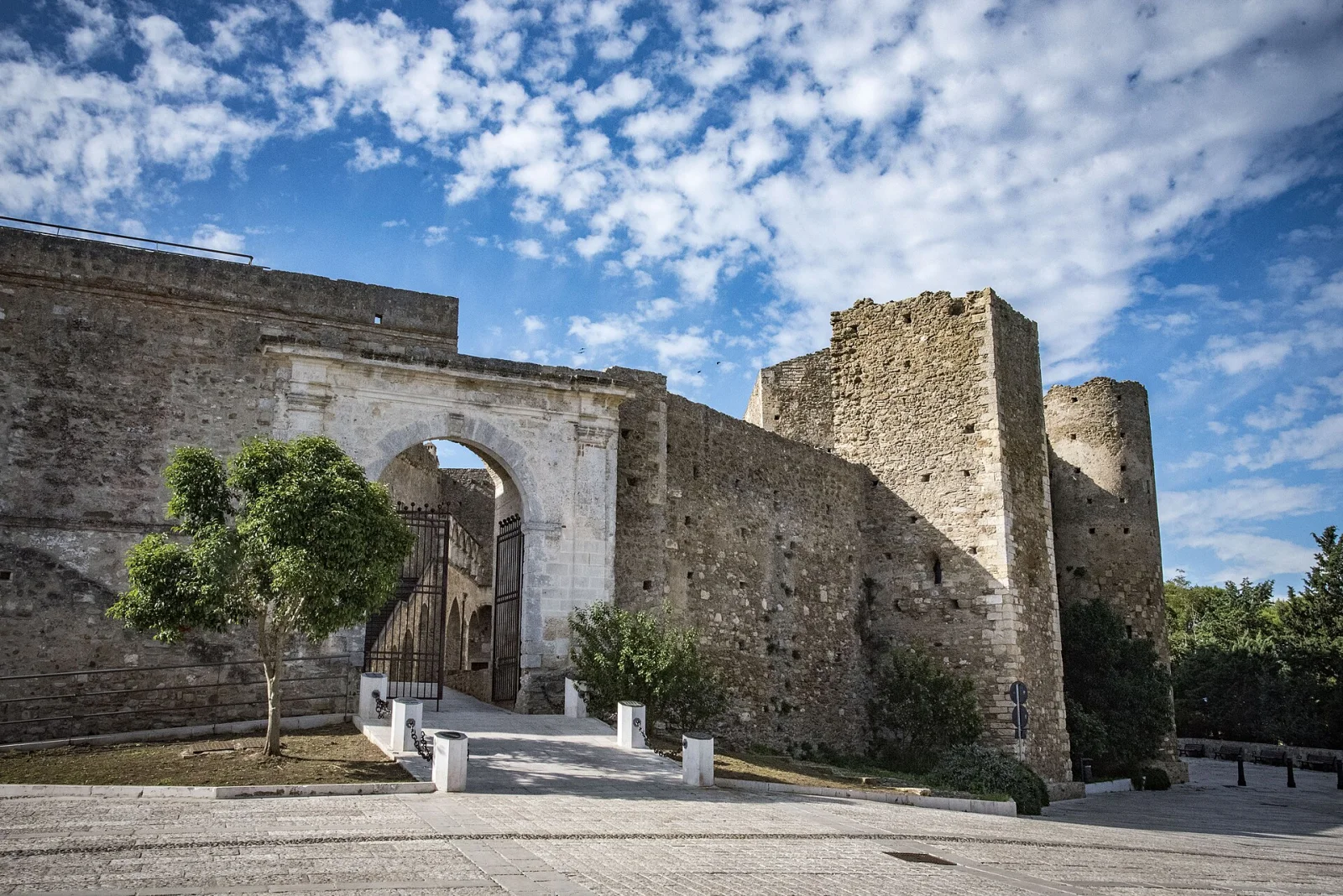
There is no entrance and no marked route: the walls are read by walking the rim of the old town, where the houses that replaced them still follow their line. The natural starting point is the Malconsiglio castle, which stands entirely outside the medieval nucleus — proof that the borgo came before the fortress — and shows seven towers, some square (the oldest ones), two twin towers and others circular. The present entrance is on the north-east; the original one, facing south, collapsed in the earthquake of 1857.
Our editors' tip
Look for porta Fontanelle on the western side and stop there: it is the only one of the four left, and from that point the names of the others work as a compass over the landscape. Pomarico to the south, 10 km away; Grottole to the west, 13 km, on the road to the Appia; Matera at 21 km. It is the same web of routes that made Miglionico, before the Basentana road existed, the obligatory passage for anyone climbing from the Ionian coast towards Potenza.