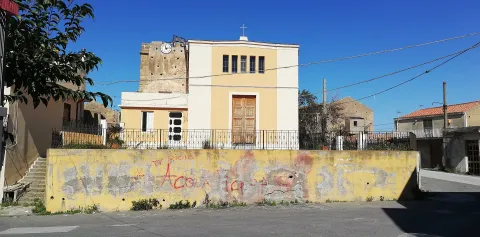
The Gurafi tower stands in the hamlet of the same name in Barcellona Pozzo di Gotto, an old fief of Castroreale, also recorded in documents as «Guraphi» or «Turafi». Along the road that climbs from Barcellona to Castroreale, on the valley floor on the left bank of the Longano stream, lies the small village: a few houses and sixteenth-century farm buildings, among them the ruins of a round tower, a church and a manor house. The place name is of Arab origin, and according to some scholars it comes from «karafa», a vessel for oil or wine, both plentiful in the area.
What to see
The round tower is partly buried and overgrown with weeds, in precarious structural condition: it is so damaged that the internal staircase, built into the thickness of the wall, can be seen from outside. Nearby stand the outer walls of the church of the Immacolata, built in 1680 and partly buried by a flood of the Longano in 1848.
The village was so large that at the end of the fourteenth century it was split into eastern and western Gurafi, with the Longano as the boundary. Its lords included Berard de Blanquefort in 1276-1277, Filippo de Puteo between 1395 and 1408, the Anzalone del Pozzo family at the end of the sixteenth century and the De Gregorio of Messina at the end of the seventeenth.
Visiting
The tower is an unstable ruin in need of restoration and consolidation: it should be viewed with care, and access should be checked with the owners or the town council.
Our editors' tip
In 1324 Castroreale was made independent and populated with the inhabitants of Gurafi and Nasari: the two villages that are now hamlets of Barcellona thus helped to populate the neighbouring town.