Patron saint festival In 45 days
Saint Andrew the Apostle, patron of the Roman baths
📅 Every year, on 30 November
Curinga celebrates Saint Andrew the Apostle on 30 November, in the mother church dedicated to him.
They call Curinga the village of the two giants, and the giants are trees. At Vrisi there is a thousand-year-old oriental plane, among the largest in Europe, and a little further down, right at the entrance to the village, stands the largest black poplar in Italy. The town sits on a hill at 380 metres looking over the plain of Lamezia and the gulf of Sant'Eufemia, and its territory falls gently from the Preserre down to five kilometres of free beach, with dunes of siliceous sand and scrub of myrtle and juniper recognised as sites of community importance. It was the first Calabrian municipality to become a supporter of the Italian national trust.
At the foot of the hills there is an enormous fossil dune, and on that dune, between 1974 and 1977, Albert Ammerman identified the remains of a Neolithic village: some forty rectangular huts with hearths, walls of reeds plastered with clay on stone footings, roofs of straw also coated with clay. The excavation of 1992 yielded tools made almost entirely of obsidian from Lipari, because this community not only farmed but passed the obsidian of the Aeolian islands on towards the Adriatic regions. It belongs to the Stentinello culture, which Paolo Orsi had recognised in 1890. One of the hypotheses about the village's name, meanwhile, derives it from curinghe, the circle in which those who had risen against their feudal lord gathered.
No events match these filters.
📅 Every year, on 30 November
Curinga celebrates Saint Andrew the Apostle on 30 November, in the mother church dedicated to him.
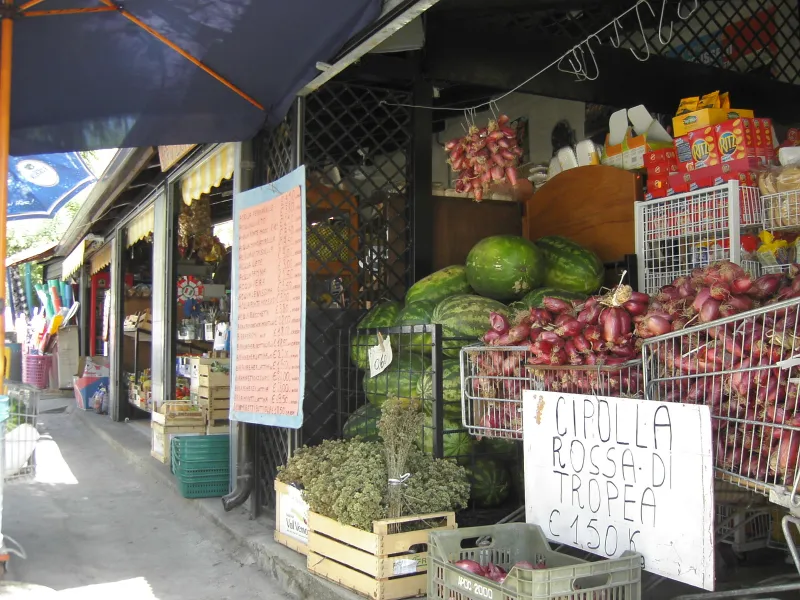
Sweet enough to go into ice cream, grown along a strip of Tyrrhenian coast: Cipolla Rossa di Tropea Calabria has held Protected Geographical Indication status since 2008.
Read more →Straight-line distances from the town centre. Tap a point to open its page.
The closest destinations covered by our editors, with straight-line distance.