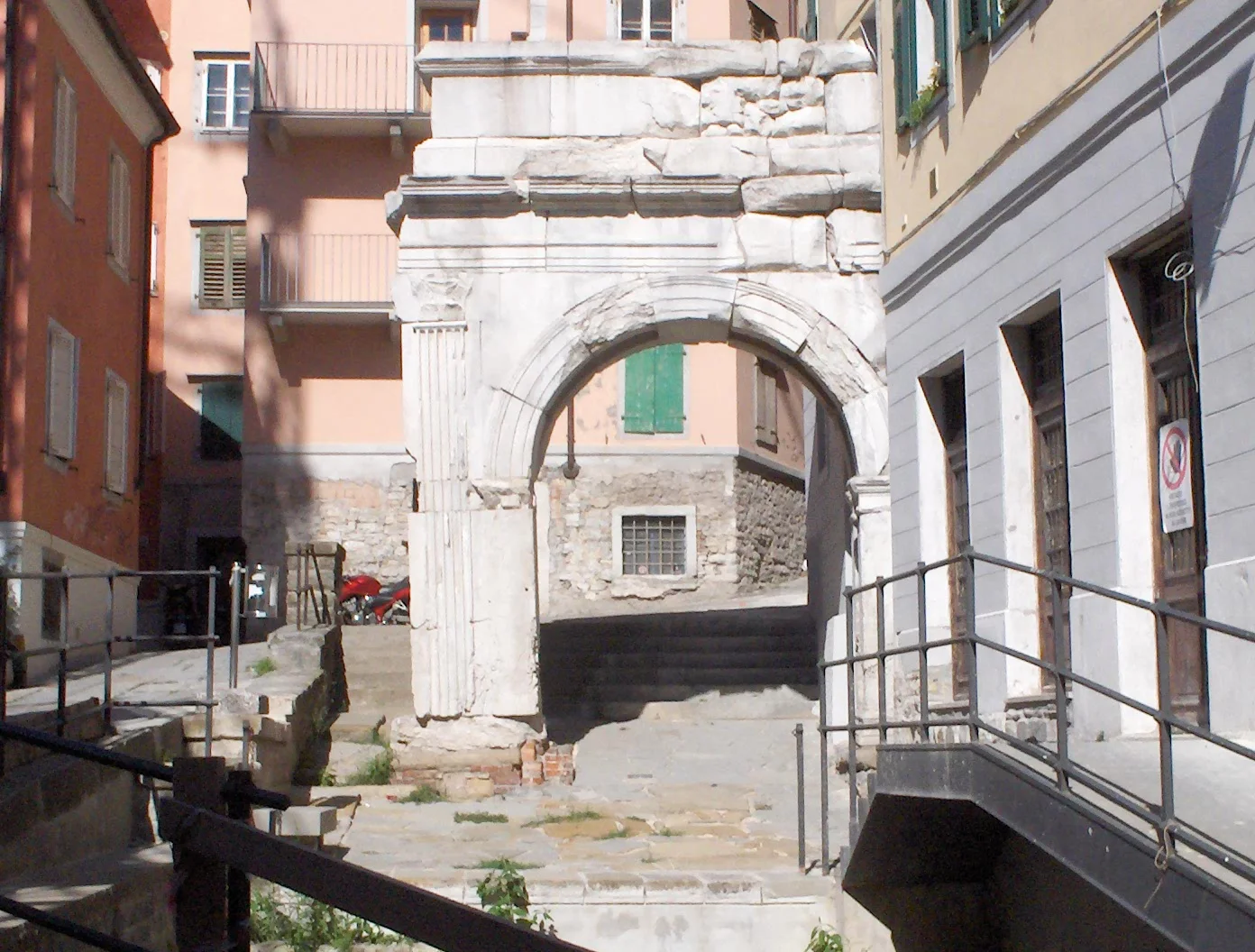
The Arco di Riccardo is, according to some sources, one of the ancient Roman gates of Trieste, dating to the 1st century BC and probably built under Emperor Augustus; according to other sources it was instead one of the entrances to the sanctuary of Magna Mater.
What to see
The forms of its architectural decoration allow the arch's present appearance to be dated to the Claudian-Neronian age, or perhaps the Flavian one, that is, to the second half of the 1st century AD. It is a single-fornix arch, about seven metres tall, roughly five wide and two deep, with a plain, undecorated upper cornice; on the sides survive traces of two fluted pilasters topped by Corinthian capitals, only one of which is now visible, while the ceiling was originally coffered. It is the only surviving stretch of the city's ancient Roman walls and, throughout the Middle Ages, remained mostly visible, though at times incorporated into surrounding buildings; the western side was fully uncovered by excavations only in 1913, while the eastern one remains embedded in a modern building to this day.
Several explanations circulate for the arch's name: a popular legend traces it to Richard the Lionheart, said to have been held prisoner in Trieste too on his way back from the Holy Land; the more credited hypothesis is that the name comes from its position at the entrance to the cardo maximus — from «Arco del Cardo» to «Arco di Riccardo» — while a third theory links it to the medieval magistracy of the «ricario», whose seat stood nearby.
Visiting
The arch can be freely seen at any time, set within the urban fabric of Trieste's historic centre.
Our editors' tip
Notice how the arch coexists today with the buildings around it, partly absorbed into them: a good example of how Roman Trieste survives, literally embedded, inside the modern city.