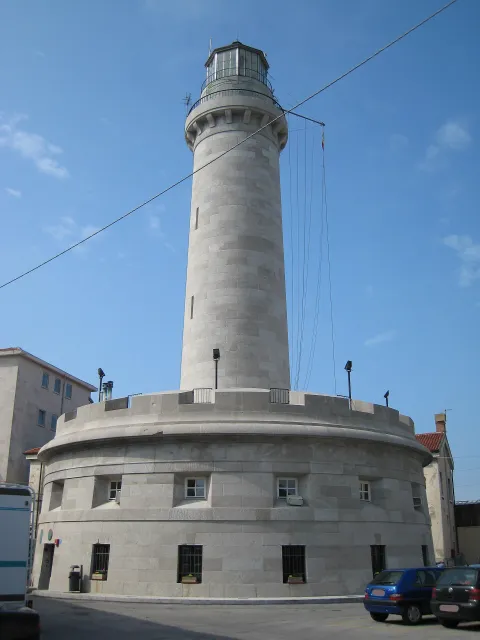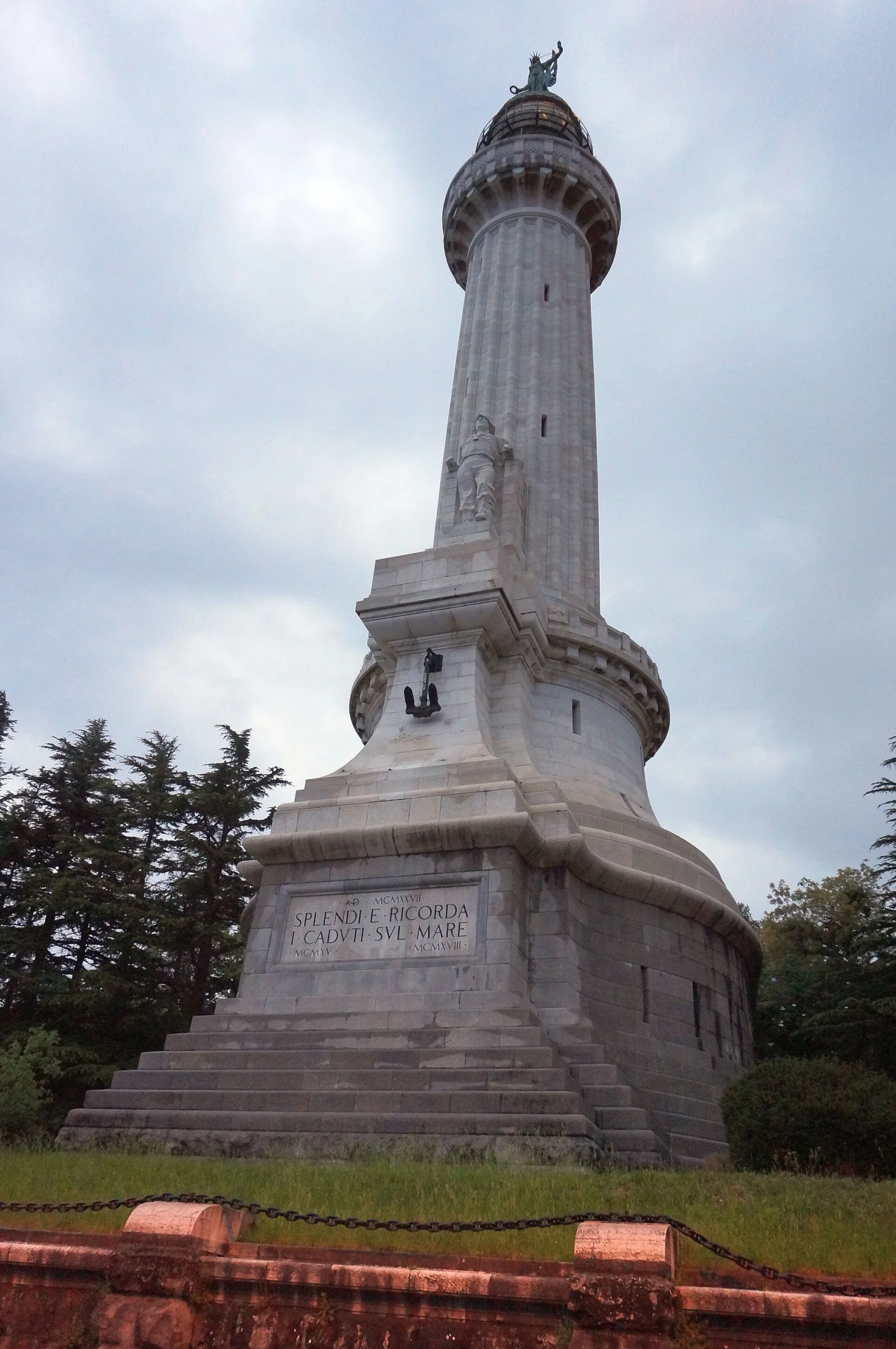
The Vittoria Light is a lighthouse in Trieste built between 1923 and 1927 to a design by the architect Arduino Berlam; besides lighting the Gulf of Trieste, it also serves as a memorial to those killed at sea in the First World War, as recorded by the inscription at its base.
What to see
The monument stands on the Hill of Gretta, 60 metres above sea level, on the old structures of the Austrian fort Kressich, dating from 1854. Berlam's original design was modified, after a heated debate, by the architect Guido Cirilli, who directed the works, while the engineer Beniamino Battigelli signed all the reinforced-concrete works and the load-bearing structure. The base is faced with stone from Istria and the Carso, while at the top of the tall column a bronze-and-crystal cage houses the lantern; according to several sources, the overall shape of the structure deliberately recalls an upside-down fascio littorio. The two large bronze statues — the winged Victory crowning the lantern and the sailor adorning the front — are the work of the sculptor Giovanni Mayer.
At the base is an anchor popularly attributed to the torpedo boat Audace, the first ship of the Regia Marina to enter the port of Trieste in 1918, though it in fact belongs to the ship Berenice; two shells from the Austro-Hungarian battleship Viribus Unitis are also displayed at the entrance. The lighthouse, closed for a long restoration, reopened to the public in 1986, but only as far as the first terrace; since 2016 the site's management has passed to the Autonomous Region of Friuli-Venezia Giulia.
Visiting
The lighthouse can be visited in limited groups for safety reasons; days and hours, subject to seasonal changes, should be checked on the official website before visiting.
Our editors' tip
Climb up to the first terrace on the clearest days: from up there the view sweeps across the whole Gulf of Trieste, the same gulf the lighthouse was built to light and watch over, alongside honouring those lost at sea.