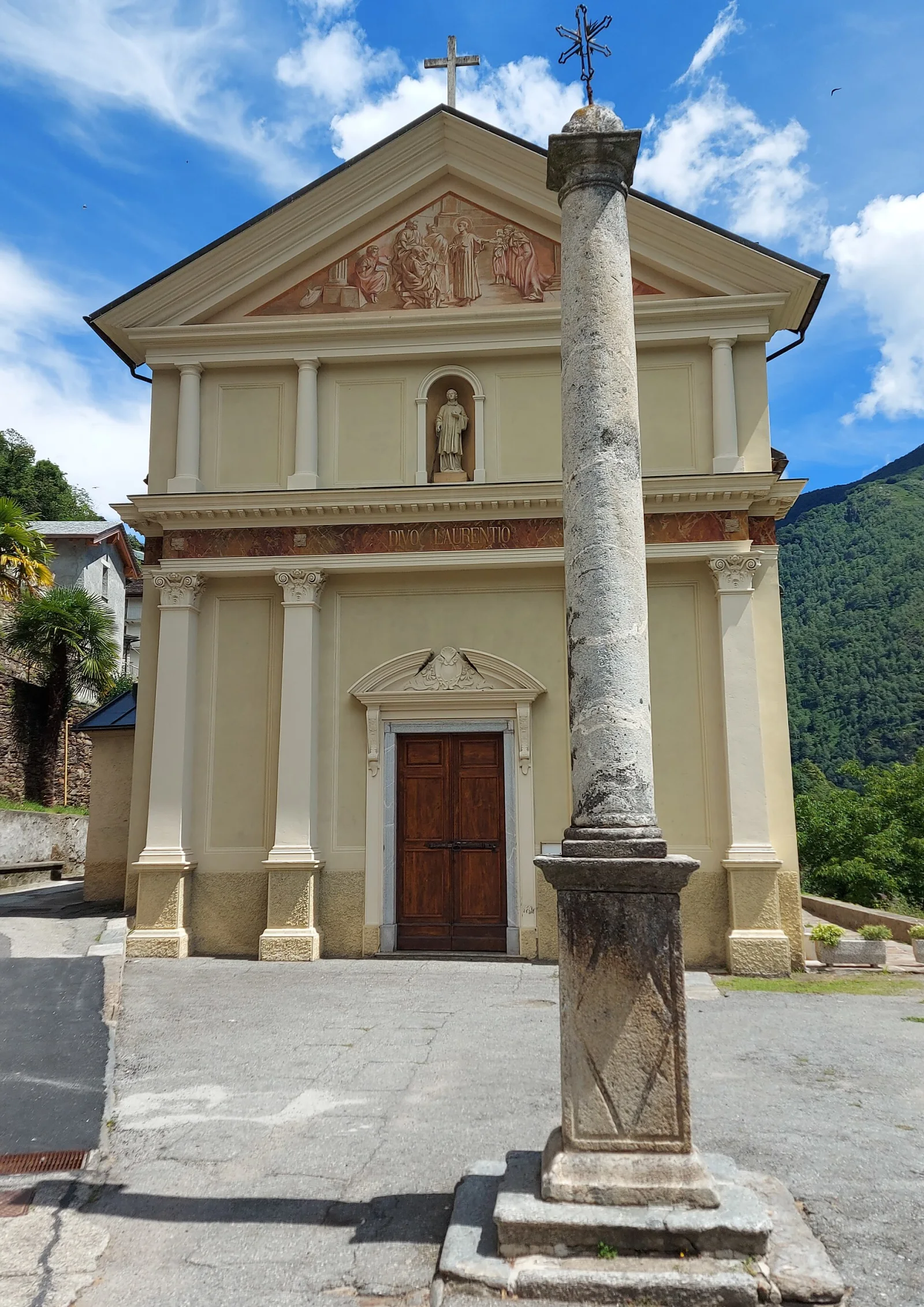
The church of San Lorenzo Martire is the parish church of Falmenta, the most populous village of the scattered municipality of Valle Cannobina, in the diocese of Novara. A place of worship here is first mentioned in 1355, when it depended on the mother church of Orasso; the present building comes from the sixteenth-century reconstruction, consecrated in 1565, and from the orders Saint Charles Borromeo left during his visit of 1574: the enlargement he demanded was carried out over the following century with the building of the side chapels. An extension of 1857 left the structure's lines asymmetrical, and between the Twenties and Thirties of the twentieth century the church was reworked once more.
What to see
The gabled facade, facing south-west, is divided by a string course into two registers: below, four composite pilasters frame the pedimented portal; above, Tuscan half-columns carry the triangular tympanum, with a niche holding a statue. Beside it rises the stone bell tower on a square base, set on a tall battered plinth, with a single-light opening on each side of the belfry: it began as a fortified tower of the Mazzarditi brothers, the tyrants who bullied the valley at the start of the fifteenth century, and only later went into the service of the bells.
Visiting
The interior has a single nave, with side chapels opening through round arches and walls marked by pilasters carrying the ribs of the vaults; the presbytery, raised by four steps and enclosed by balustrades, ends in the apse. The most precious work is the pyramid-shaped wooden altar, richly decorated, bought in 1678 from the gilders Antonio Pino of Bellagio and Paolo Giussani of Angera — or perhaps, the sources say, brought from Milan.
Our editors' tip
Before going in, it is worth walking around the bell tower: it is the oldest and strangest document of the complex, a bully's tower recycled into a tower of prayer. The parish's history tells the rest: at the end of the sixteenth century Falmenta broke free of Orasso together with Gurro, and full autonomy came at the start of the seventeenth, by decree of archbishop Federigo Borromeo — the hierarchies of a valley where even churches were emancipated by degrees.