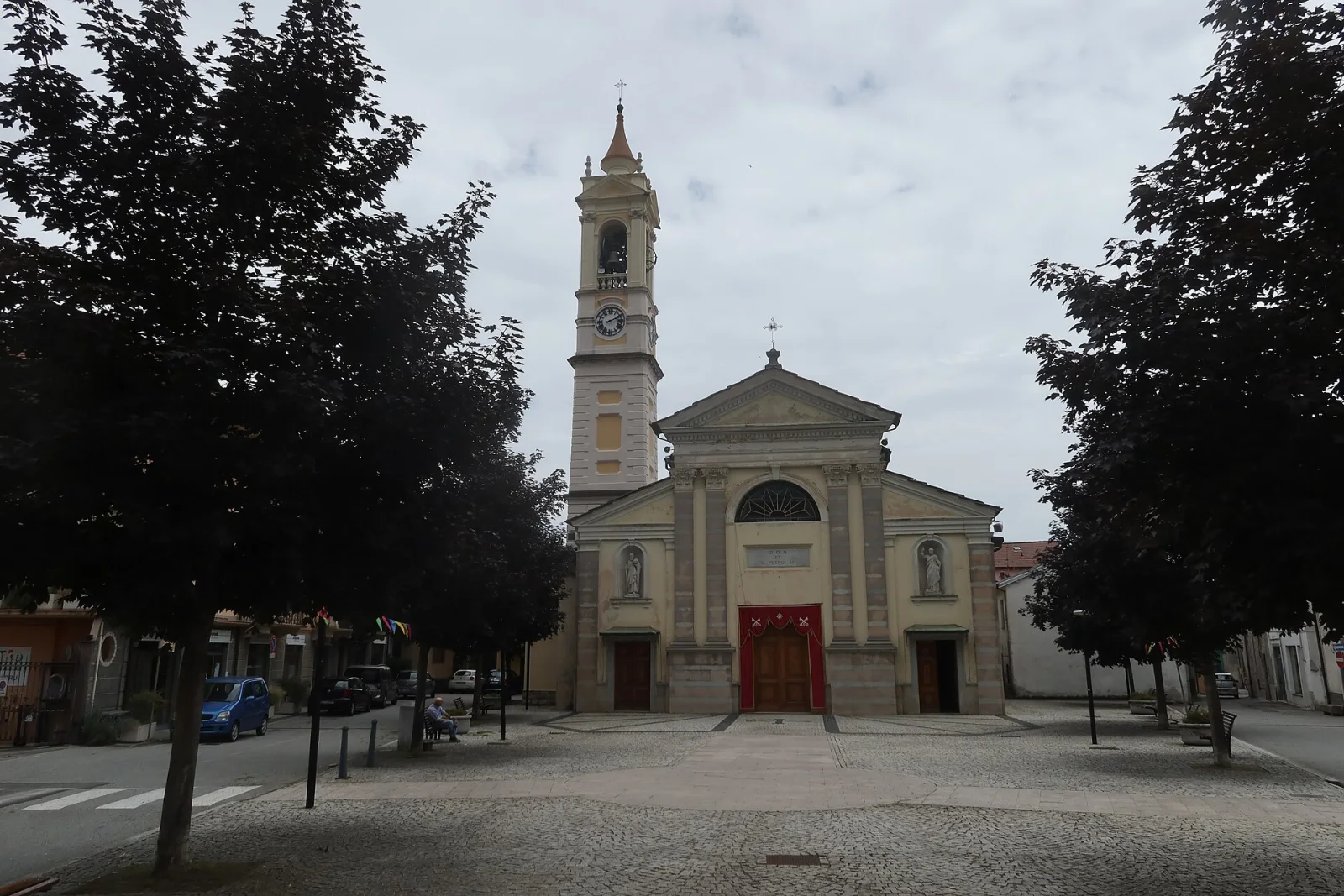
The church of Saint Peter the Apostle is the parish church of Gravellona Toce and belongs to the diocese of Novara. A place of worship dedicated to Saint Peter already existed in the twelfth century; the church you see today is instead a seventeenth-century work, consecrated on 17 August 1696 by the bishop of Novara, Giovanni Battista Visconti. At the moment of its consecration it was anything but finished: the front was completed only in 1862, to a design by the architect Pompeo Azari, and three years later work began on the bell tower.
What to see
The gabled front faces west and is divided vertically into three parts marked off by pilaster strips. The central one, taller, carries the main portal with a semicircular window above it, and closes with the pediment; the two side wings have secondary entrances with lintels and niches holding statues. The bell tower, set against the church, is of stone on a square base, with pilaster strips at the corners; each side of the belfry opens with a single-light window guarded by balustrades, and the spire on top was added in 1930. Inside, three naves divided by piers carry round arches, above which runs a moulded and projecting cornice from which the lunetted vaults spring. At the end of the hall the presbytery rises two steps around the high altar and closes with a semicircular apse.
Visiting
The church tells you a good deal about how village parish churches were built: bay by bay and generation by generation, as money allowed. More than a hundred and sixty years separate the seventeenth-century consecration from the nineteenth-century front, and the spire of the bell tower only arrives in the twentieth. The updates did not stop there: in 1970, following the instructions of the Council, the ambo and the celebrant's chair were installed, while the altar facing the congregation dates from 2009; the bell tower was restored in 2016.
Our editors' tip
Look at the front from a distance, from the far end of the tree-lined square: that is where Pompeo Azari's design works best, with the three parts climbing towards the pediment and the bell tower acting as a counterweight to one side. Then come close to the side niches, which are lost from far off. It is worth arriving here after seeing San Maurizio, the Romanesque church at the other end of the village: they are the two ends of Gravellona's religious history, a thousand years between the bare stone blocks of one and the plastered pilasters of the other, and ten minutes on foot.


