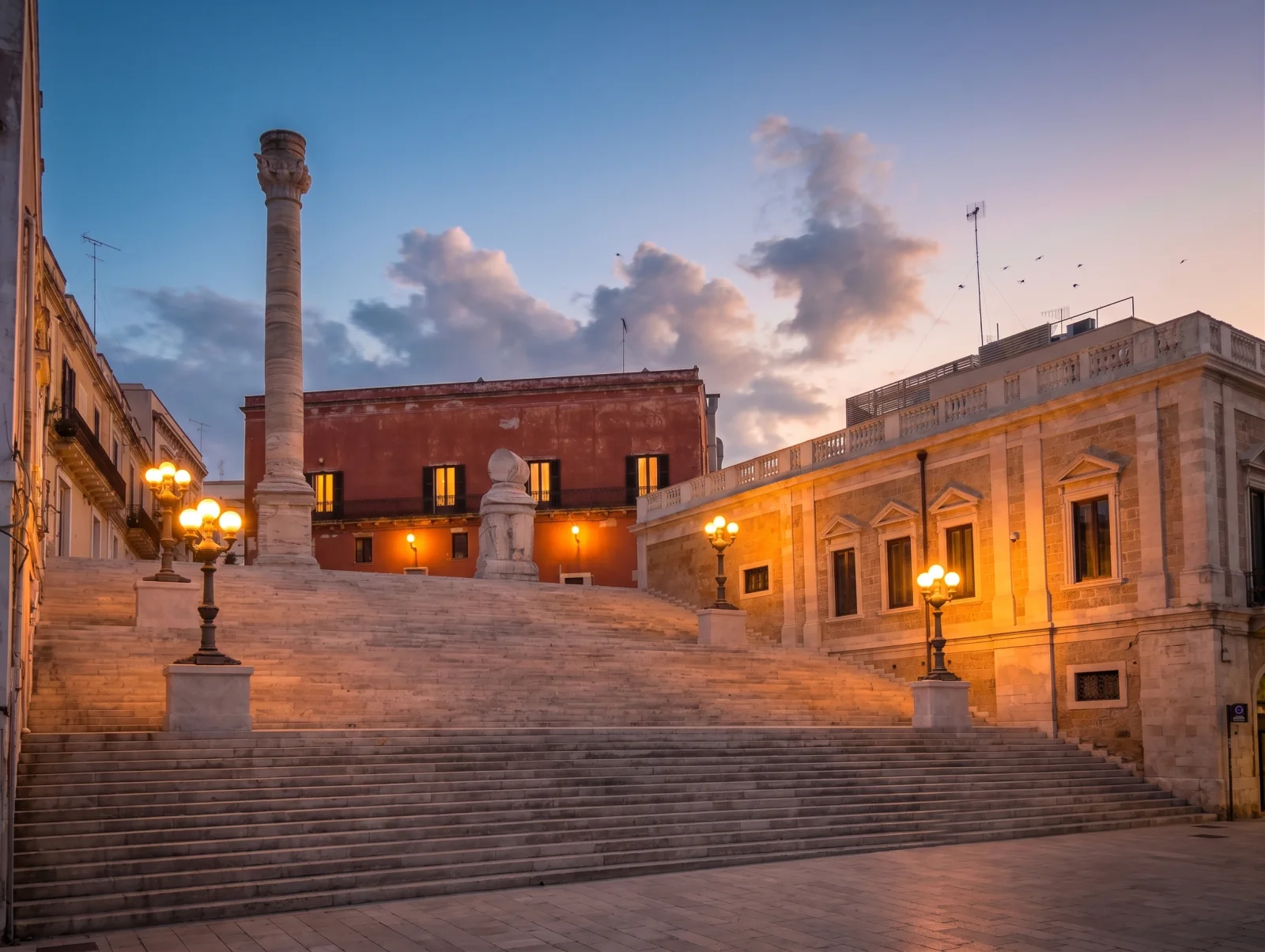
The Palazzo Granafei-Nervegna is a historic palace in Brindisi, on via Duomo, named after the two families that owned it.
What to see
The original core of the building dates from at least 1565, when the owner was Nicolò Granafei: the palace is documented for the first time in that year, «in vicinio Sancti Pelini». The construction is in Renaissance style, with cornices that mark three orders. The main façade has decorations and windows each different from the others and a portal with the family coat of arms, a rampant lion carrying an ear of wheat, «granum fert», alluding to the presumed etymology of the surname. On 24 October 2009, in the palace's exhibition rooms, the exhibition «L'eredità del Novecento. I capolavori della Collezione Mazzolini» was inaugurated, which until 24 January 2010 allowed visitors to admire over a hundred works by major Italian artists of the twentieth century, among them Giorgio de Chirico, Massimo Campigli, Mario Sironi, Filippo de Pisis, Carlo Carrà, Lucio Fontana, Giuseppe Capogrossi and Piero Manzoni.
According to tradition the Granafei family came from Constantinople, from which it fled when the city was taken by the Turks of Mehmed II, taking refuge in Oria; in 1508 it moved to Brindisi, where Ferdinand of Aragon was offering many incentives to repopulate the city. In 1862 the Granafei, by then moved to Mesagne, sold the palace to the brothers Luigi and Giuseppe Nervegna, a merchant family originally from Ortona, who ran a company trading in Apulian agricultural products. Giuseppe, a learned man with a passion for archaeology and numismatics, was president of the Chamber of Commerce of Terra d'Otranto from 1869 to 1881 and campaigned for the development of the ports and the railway. On the death of the two brothers, in 1908, the family's business ceased; in 1921 the building was sold and in 1930 the palace with its garden passed to the Comune of Brindisi, which made it the seat of the Court, the Assize Court and the Pretura until 1976.
Visiting
The palace is on via Duomo, in Brindisi. The sources consulted give neither hours nor what it is used for today: these should be checked on the spot or with the Comune.
Our editors' tip
Read the four Latin aphorisms on the cornices: among them «the wise woman builds her house; the foolish one tears down with her own hands what has been built» and «do not love sleep, lest you come to poverty».


