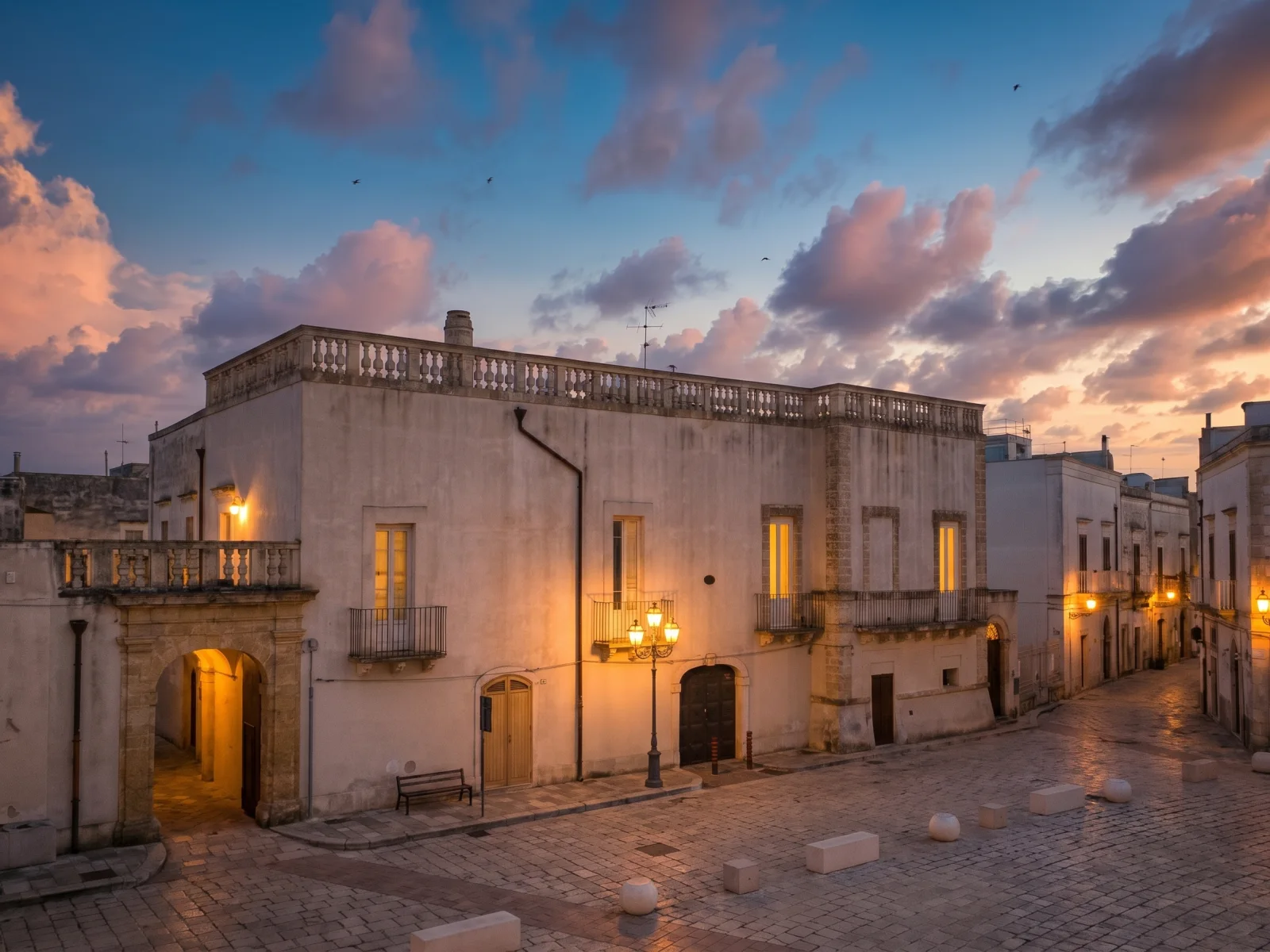
In 1750 the people of Cellino, worn out by famine and taxes, stormed the count's palace. That palace, in Largo Castello, was originally the village's medieval castle: in 1578 count Giovanni Antonio Albrizzi, who had bought the fief from the royal court, turned it into a lordly residence and enlarged it; his son widened the part of the square tower again; and from 1742 count Nicola Pasquale Chyurlia gave it its present shape, adding the left wing and having the arms with the rampant lions carved on the stone of the entrance. In the land register of 1756 the palace was still recorded as his; then it was sold, passed from hand to hand and ended up abandoned. For some years now it has been recovered, and the civic museum has been put in it.
The parish church, instead, tells of another change. The oldest one stood at the edge of the castle and had been founded in the eleventh century as a chapel of Basilian monks, dependent on the abbey of Sant'Andrea near Brindisi; in the fifteenth century, after the Greeks were driven out, it was abandoned, but meanwhile the population was growing, and in 1693 the church was rebuilt from scratch in baroque style, with two twin bell towers ending in spires. The oldest find of the territory, on the other hand, is no longer to be found: it was an eneolithic oven-shaped tomb inside the wood of Li Veli, and today it cannot even be located. During the Risorgimento a Carbonari lodge was formed at Cellino, called The Plebs at the Sacred Mount, and a section of Young Italy; the comune passed from Lecce to the new province of Brindisi in 1927. Here, in 1943, the singer Al Bano Carrisi was born.