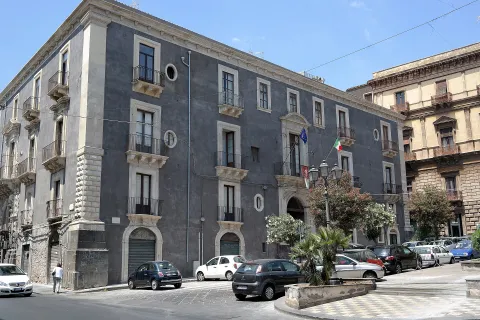
The sources describe this building as being of gothic-orientalising taste, and put like that it sounds like a fantasy out of a catalogue. In Sicily, though, it is not: gothic and Arab forms really did live together here, in the Norman monuments of the twelfth century, and a Sicilian architect who in the twentieth century mixes the two is not inventing an elsewhere, he is quoting the island.
What to see
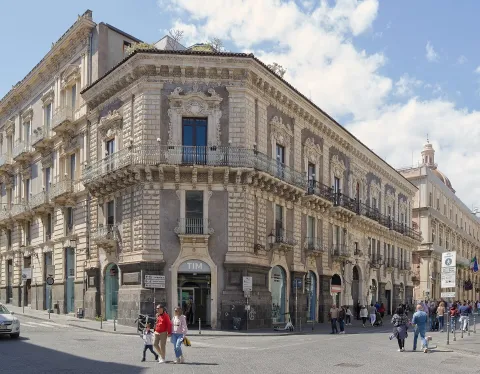
The villino Citelli stands in via Tomaselli, at number 31, and was built between 1904 and 1907 by the architects Paolo Lanzerotti and Salvatore Sciuto Patti. The style falls within what scholars call Catanese eclecticism-liberty, with a gothicising layout: pointed arches, verticality, decoration that concentrates on the profiles rather than on the flat surfaces. It is a language used all over Europe in those years for the houses of those who wanted to stand out, and here it finds one more reason to exist.
What makes this building different from the other small villas of the same season is what became of it. Today it belongs to the University of Catania, which has placed in it the unit that deals with international relations. A villino born for a family, and designed to astonish passers-by, has thus become the office where the paperwork is handled for students going abroad and those arriving. It is probably the reason it is still standing and in good condition: private buildings of this kind survive when somebody needs to use them.
Visiting
It is not a museum and there are no visits: it is a working university office. Unlike almost all the other liberty villas of the city, though, this one houses a public office, so during opening hours the entrance is not necessarily barred. Ask the staff whether you may take a look at the entrance hall, and take your cue from the answer, without insisting. A quarter of an hour.
Our editors' tip
Look at the profiles, not at the walls. In a gothicising building all the work is in the outlines: the point of the arches, the edge of the windows, the eaves line, the pinnacles if there are any. Try following the perimeter of each opening with your eye, as though you had to trace it, and you will notice that the design lives there, while the surfaces in between are almost always left plain. It is the exact opposite of what the baroque does, filling surfaces and softening edges. Two opposite ways of decorating, in the same city, two centuries apart.