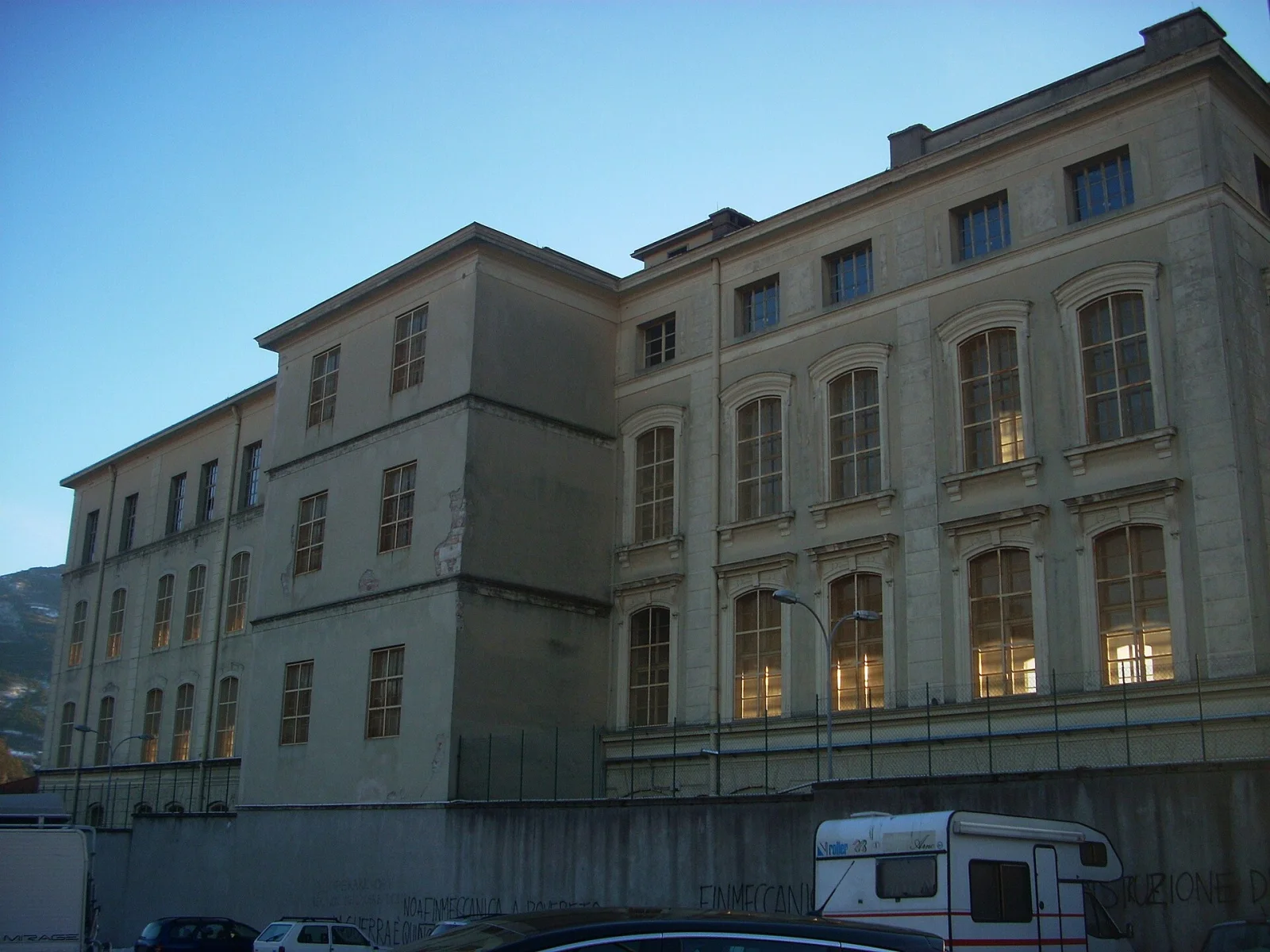
Palazzo Fedrigotti, on corso Bettini in Rovereto, was built in the last decade of the eighteenth century for Giovan Pietro Fedrigotti, who in 1790 had been made a count of the Holy Roman Empire. The Fedrigotti, from Sacco, had grown rich on timber, silk and, from 1750, the privilege of running the postal traffic between Calliano and Torbole. The design is by Ambrogio Rosmini, a Rovereto architect and painter, who gathered it in an album of twenty plates signed with an anagram; the building work was by the master mason Carlo Caminada. By 1796 the palace must have been finished, because Napoleon Bonaparte lodged there with his retinue.
What to see
It is a Neoclassical building in a town that was then still Baroque. The front on the corso, with ground floor, main floor and mezzanine divided by thin bands of white stone, is smooth, without rustication at the corners, and relies entirely on the even rhythm of the windows: the only sculptural element is the stone portal, which marks the centre.
Inside is a circular courtyard, recalling that of Caprarola, faced on the ground floor with the same rustication as the exterior. Some rooms are decorated with stucco.
Visiting
Since 2005 the palace has been part of the University of Trento, which has offices and laboratories there: access to the interiors should be checked with the university.
Our editors' tip
The Fedrigotti kept it until 1920, when it passed to the institute of the English Ladies, which made it a girls' boarding school. Before that, its guests had included Eugène de Beauharnais, viceroy of Italy, and in 1810 the palace was the seat of the sub-prefecture of Rovereto.


