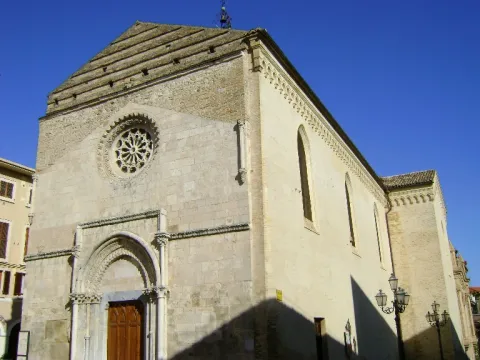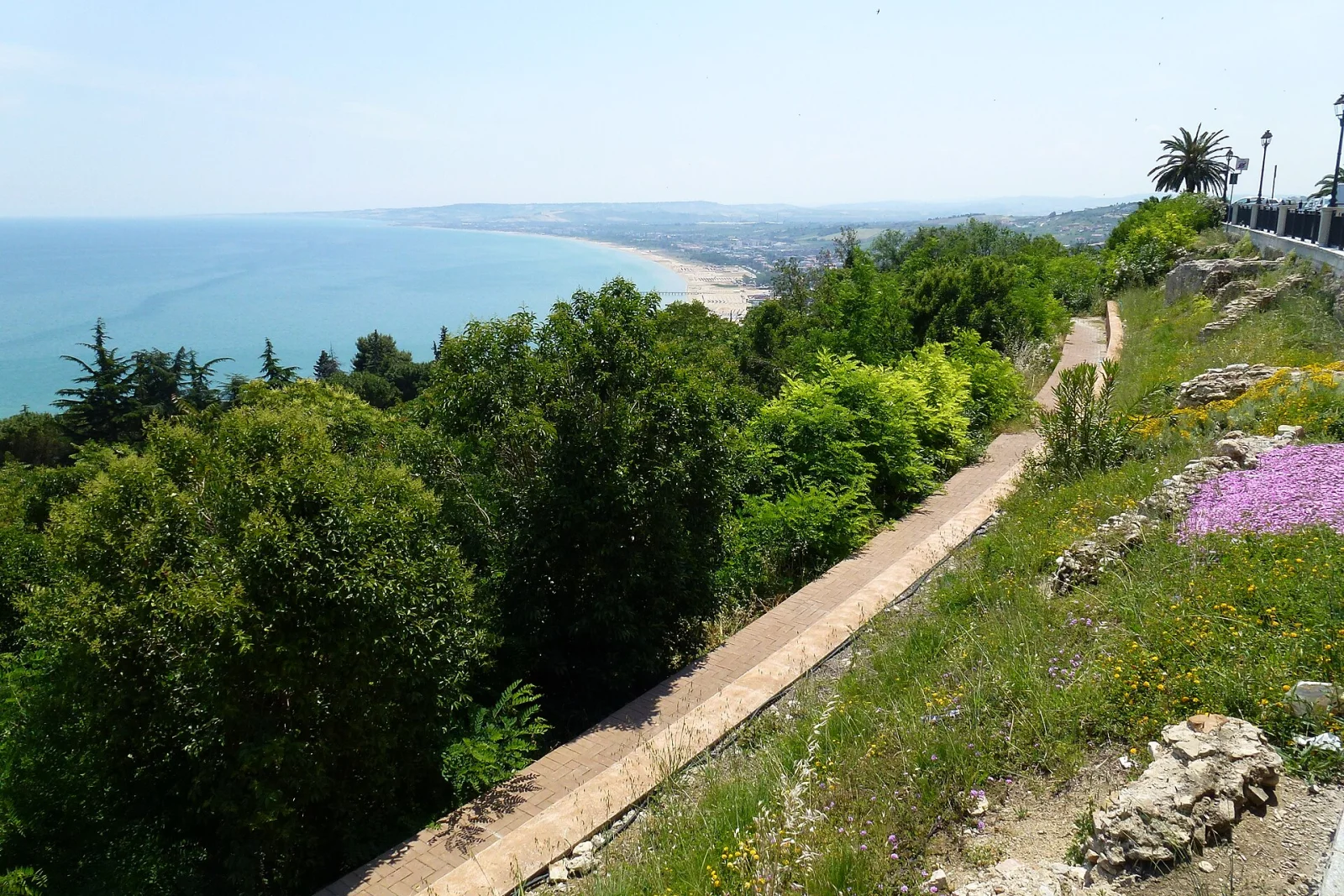
The baths of Vasto are the bath complex of ancient Histonium, Roman Vasto. They lie along via Adriatica, in the part of the centre struck by the landslide of 1956: here the trial excavations of the heritage office, in the early seventies, brought to light a brick-built complex datable to the second century. To dig more easily it was decided to demolish the former Franciscan convent of the church of Sant'Antonio di Padova. The complex has thirteen rooms, arranged on three levels along the natural slope, and part of it is still buried under the road and under the church.
What to see
The Neptune mosaic, discovered in 1997, is the largest: 170 square metres, though part of it remains hidden beneath the sacristy of Sant'Antonio. Interlaced stylised plant motifs mark out thirteen quatrefoil fields; in the centre is Neptune, with trident and a dolphin, and around him three Nereids, two riding horses and one a dragon, tritons and a cupid. The pool was most probably a frigidarium, because the room was too large to be heated and no furnace has been found.
The smaller marine mosaic came to light in 1974: it was taken for some twenty years to the Archaeological Museum in Palazzo d'Avalos and then put back in place after restoration. It shows sea horses, fish, dolphins, octopuses and a sea tiger with a fish tail. Both mosaics are in black and white, a technique common in African floors: for this reason they are attributed to North African craftsmen, called to Histonium by the local family of the Hosidii Getae.
Visiting
The baths are reported to be open to the public at weekends in summer; for the other seasons, and for times and arrangements, it is best to check with Vasto town council.
Our editors' tip
Look at the floors without figures too. In one of the lower rooms, near the corridor, the floor is made of reused marbles of different thicknesses, taken from older buildings: among them is the slab with the dedication of Iulia Cornelia. It is the sign of the restoration that followed the earthquake of 346 AD.