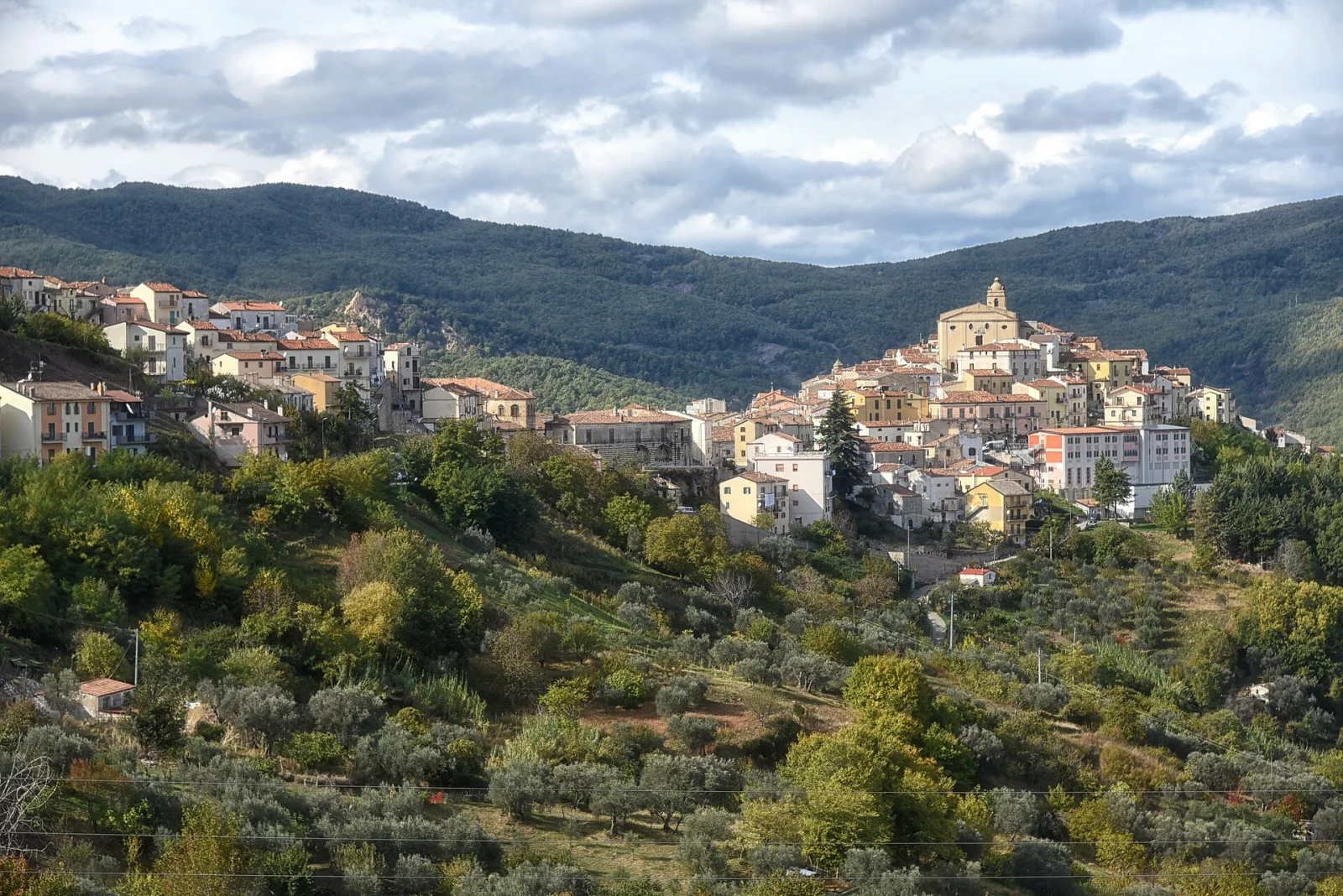
In Accettura, on Whit Sunday, a large oak stripped of its branches is raised in the village square and the top of a smaller tree is grafted onto its tip: this is the Maggio, the feast of the patron saint Julian. The museum of tree cults exists to explain why a village keeps doing such a thing. It is an ethno-anthropological museum, opened in 2005 by mayor Vincenzo Amoia, and it gathers the legacy of the research of Giovanni Battista Bronzini and the anthropologist Ferdinando Mirizzi.
What to see
The display lines up paintings, collections of photographs and videos of the festival, and then the tools of peasant life and forest work: the same hands that cut, drag and raise the tree in May used those implements all year round. Alongside are a library of texts on tree cults in Italy and Europe and a video archive of films of the Maggio festivals, the part hurried visitors skip and the part that holds up everything else.
The second thing the museum does is draw a map. Tree rites survive in very few places around the Mediterranean, and here they are set out one by one: in Basilicata, Accettura, Oliveto Lucano, Pietrapertosa and Castelmezzano; on the Pollino, between Basilicata and Calabria, Rotonda, Viggianello, Terranova di Pollino, Laino Borgo, Alessandria del Carretto and Castelsaraceno; and scattered across Italy, Ponte Nossa, Pastena, Vetralla, Castel Giorgio, Bajardo, Baiano and Terrasini. Among ethno-anthropological museums, the one in Accettura is perhaps the only one of its kind in Europe.
Visiting
The museum stands inside the Gallipoli Cognato - Piccole Dolomiti Lucane nature park and doubles as its visitor centre, which makes it the place to stop before heading up to the woods, to the enclosures with fallow deer and red deer or to the archaeological area of Monte Croccia. Begin with the films and only then move on to the tools: in the reverse order they stay mute objects.
Our editors' tip
If you come for the Maggio, go into the museum before, not after. The festival lasts for hours, is followed from within the crowd and does not explain itself, while the video archive keeps films of past editions and sends you into the square knowing what you are looking at. Ask about Bronzini too: the book he devoted to the village in 1979, Accettura: il contadino, l'albero, il santo, has in its very title the whole triangle the museum recounts.