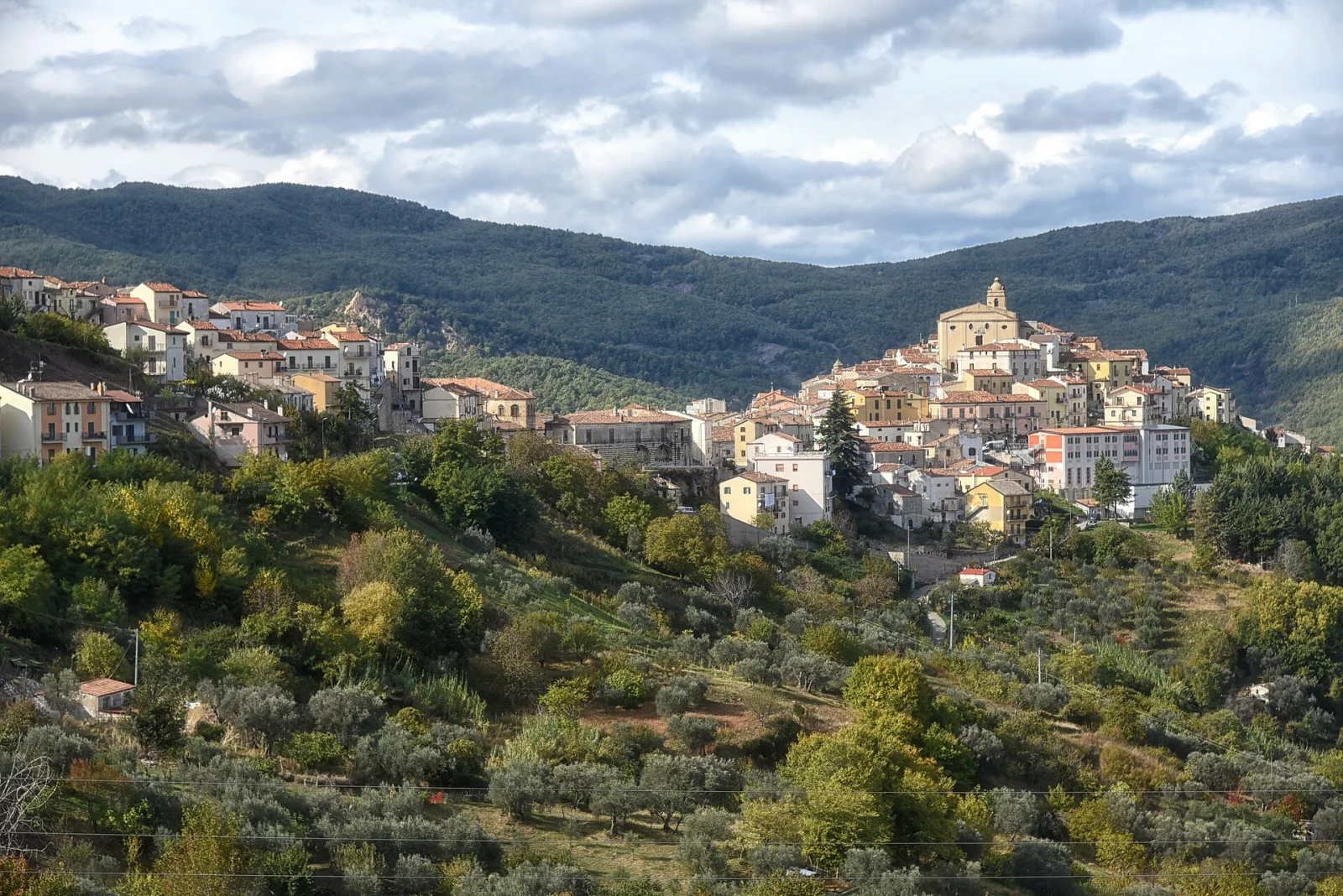
Monte Croccia looks down from the south over the Basento valley, and on its summit, at 1149 metres, run the walls of an Oscan-Samnite fortified settlement: the outer circuit dates from the eighth century BC, the inner one from the fourth, and after the third century BC excavations have turned up nothing more, a sign that Roman pressure closed the site's history. 200 metres east of the main gate stands what earns the whole place its megalithic name: the Petre de la Mola, an outcrop of calcarenite that someone, probably as early as the Bronze Age, reworked into a calendar of stone.
What to see
There are two circuits of walls, sharing their southern side. The outer one measures 1340 metres and is built of regular sandstone blocks with a fill of small stones and earth: vegetation now hides most of it, but a restored stretch of sixty metres shows how it was made. The inner one, from the fourth century BC, is 679 metres long, encloses three hectares of acropolis and was raised using Greek building techniques. It has five entrances: a well-preserved court gate with an almost square opening, two small passage doors on the north side and two posterns on the south.
The Petre de la Mola lie at 1049 metres, just below the summit. In 2008 a laser scanning survey documented two alignments there linked to the winter solstice: the sun, by then a few degrees above the horizon, sets through the cleft between the largest boulders, and at midday it settles into a small hollow in the rock. Fifty metres below the outer fortification, at the Acqua Fra Benedetto spring, Vittorio di Cicco identified a sanctuary in use in the fourth century BC.
Visiting
The approach is from the Gallipoli-Cognato forest, inside the regional park, and an equipped path follows the perimeter of the fortification: the simplest way not to miss the stretches of wall the Turkey oak wood conceals. From the high ground you can pick out Civita and Serra del Cedro near Tricarico and the villages of Accettura and Albano di Lucania. The first investigations date from 1885, with Michele Lacava; then came those of Vittorio di Cicco and, in 2011, a survey of the structures still legible on the surface.
Our editors' tip
Stand on the threshold of the monumental gate and look east, towards the Petre de la Mola: at the equinoxes the sun rises exactly behind those boulders. It is the clue that the rock still counted for the people who raised the walls, centuries after someone else had chosen it. Go when the light is low, early morning or late afternoon: among the oaks the stones read far better.