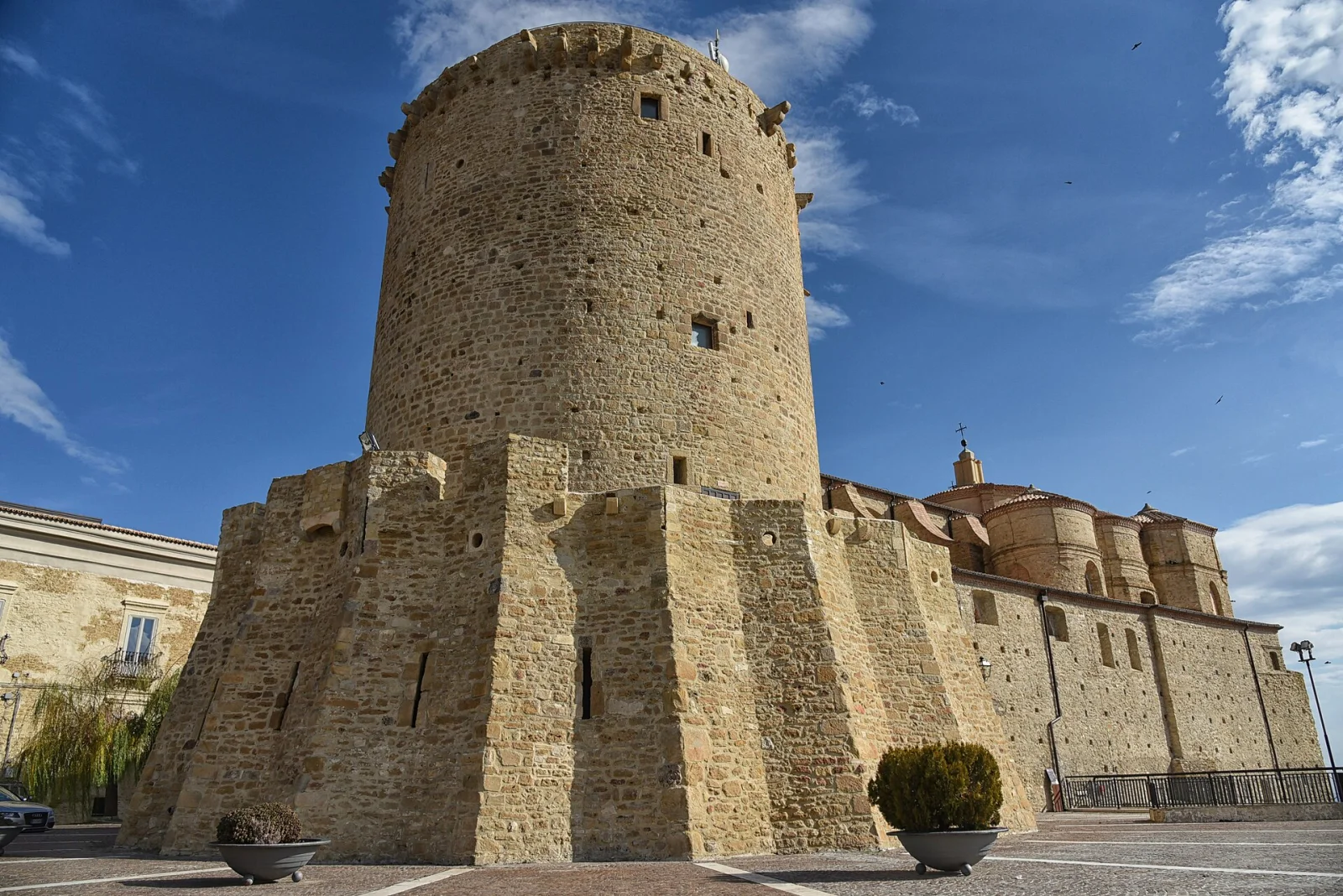
25 metres of cylindrical tower planted in the main square: in San Mauro Forte the monument does not sit on the edge of town, it sits exactly in the middle. The present settlement dates from the Norman period, presumably to 1060, and grew up around a Benedictine monastery dedicated to Saint Maurus; it was fortified all the way round, with four gates of which one is still in place, and on the east side this three-storey tower went up, facing outwards then and standing in the middle of village life now. The adjective «Forte» came much later, to commemorate 1861, when San Mauro drove off the brigand bands of the Spaniard Borjes.
What to see
The base is the surprising part: the cylinder rests on a polygonal bastion with a zigzag scarp, a broken profile designed to deflect artillery fire. It is not Norman. The tower you see today was completely rebuilt in the years after 1450, and scholars set it alongside the cylindrical tower of Bitonto: the same division of volumes over three floors, the same bastioned base, the same zigzag scarp traceable to the precepts of Leon Battista Alberti, to the point that the two structures look like the work of a single design.
Inside, the tower was equipped to stand on its own: an ingenious pulley system and a rainwater collection network fed by cisterns. For years it was believed to have been flanked by twin structures, as in the Frederician castles; today we know it was conceived as a single keep, a defensive outpost and the seat of the garrison. Its profile has been reproduced for centuries in paintings and in local family coats of arms, and in the nineteen-eighties it made it into the philatelic series devoted to castles.
Visiting
No signposting is needed: the tower is in the main square and you see it from whichever side you enter the old centre. Look at the base first and walk all the way round it, because the zigzag scarp changes appearance every few steps and it is the reason architects study this structure. Behind the tower stands the church of Santa Maria Assunta, built in 1553, which keeps a sixteenth-century processional cross and an eighteenth-century canvas.
Our editors' tip
If you can choose your date, come on 16 January: that is the day the Campanaccio festival begins. Groups of men move through the streets with big cowbells held between their legs — the male ones longer, the female ones wider — and they set off with three turns around the church of San Rocco, where the image of Saint Anthony the Abbot is kept. The processions stop near the wine cellars, where wine and sausage are handed out, and start up again until deep into the night.