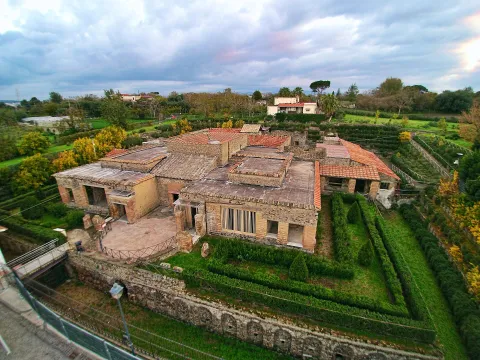
The castle of Cicala, also called Castelcicala, stands on the top of the hill of the same name, in Nola. There is no certain information about its origins: according to some historians it was built by the people of Nola in the fifth century, after the Vandals of Genseric had devastated the town below; according to others it is the work of the Lombards, of the princes of Benevento. A document of 934, kept at the abbey of Montevergine, describes it as partly destroyed. It was restored between the eleventh and twelfth centuries under the Normans, perhaps through the intervention of Roger II: in that period it was surrounded by walls and served as a base for keeping Naples under siege.
What to see
There remain the curtain walls, which you can climb by several stone stairways, and inside them a courtyard. The rooms have been restored and are used to host events.
The owners were many. In 1269 Charles I of Anjou gave the county of Nola, castle included, to Guy de Montfort; then came the Orsini, who held it for about two centuries, until 1532, using it little and entrusting it to a castellan. In the seventeenth century it changed hands several times: in 1640 it was sold to Ladislaus, King of Poland, and in 1660 it went to the Ruffo, who lived in it until the unification of Italy. The last lay owners, the counts Sallier de la Tour, gave it to the Capuchins.
Visiting
Since the rooms are used for events, whether and when the castle is open to visitors should be checked before going up.
Our editors' tip
The name has nothing to do with the insect, the cicada: it is said to come from the Greek «gea calos», that is, beautiful land.