Before it was an archaeological site, Pompeii was a living town for eight centuries, on a shelf of lava rock nearly thirty metres above the plain, close to the mouth of the Sarno. The position was no accident: there were no springs in the area, and the river was at once the water supply, the way inland and the harbour. Greeks and Etruscans controlled the town without ever taking it by arms, leaving it a degree of autonomy.
What to see
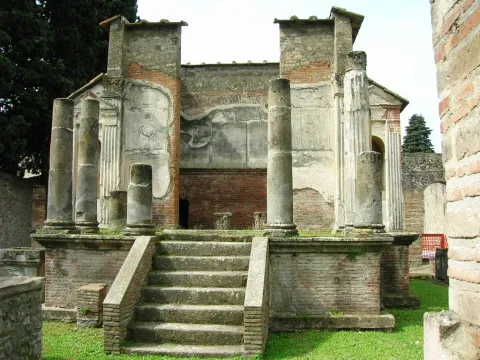
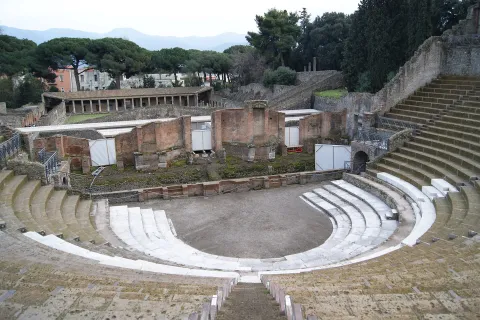
Of the Greek presence there remains the Doric Temple, built not in the centre but off to one side, in what would become the Triangular Forum: what interested them were the roads and the port, not settling here. The Etruscans, who reached the plain towards the end of the 6th century BC, brought the Tuscan atrium into the houses, the temple of Apollo and a first square used as a market. But the town you walk through today is Samnite above all in its layout: between the 3rd and the 2nd century BC Pompeii reached its final perimeter, with the walls strengthened in Sarno stone and a trade in wine and oil that reached Provence and Spain.
Visiting
In the walls between porta Ercolano and porta Vesuvio you can still see the marks left by the heavy stone projectiles with which Sulla's army pounded the town during the Social War. The Pompeians had sided against Rome because senators were carving up the land around them while Roman citizenship was denied them; they held out for a long time and fell only in 89 BC, almost without damage. Shortly after, in 80 BC, the town became a colony under the name of Colonia Cornelia Veneria Pompeianorum, yet Latin cancelled nothing: Oscan and Greek went on being spoken, as the graffiti show, and for about half a century people went on measuring in Oscan units. On the housefronts the painted election notices remain, with the names of the districts: Forenses, Campanienses, Salinienses.
Our editors' tip
The last day has a timetable. Around one o'clock a roar announced that the plug of hardened magma had given way; in some five hours the rain of ash and lapilli reached a metre deep and the first roofs gave in. At six the next morning a pyroclastic flow reached the walls, another at seven, another a few minutes later, the last and most violent at eight: whoever had survived died then. Of the roughly 1150 victims recovered, 394 lay in the lower layers of lapilli, crushed by fallen roofs, and about 650 higher up, in the open, caught by the burning clouds. Most Pompeians, though, had already fled. Those who ran towards porta Ercolano did not make it; those who left by porta Stabia had one more chance, except that the sea was rough from the tremors and the boats almost all destroyed.