
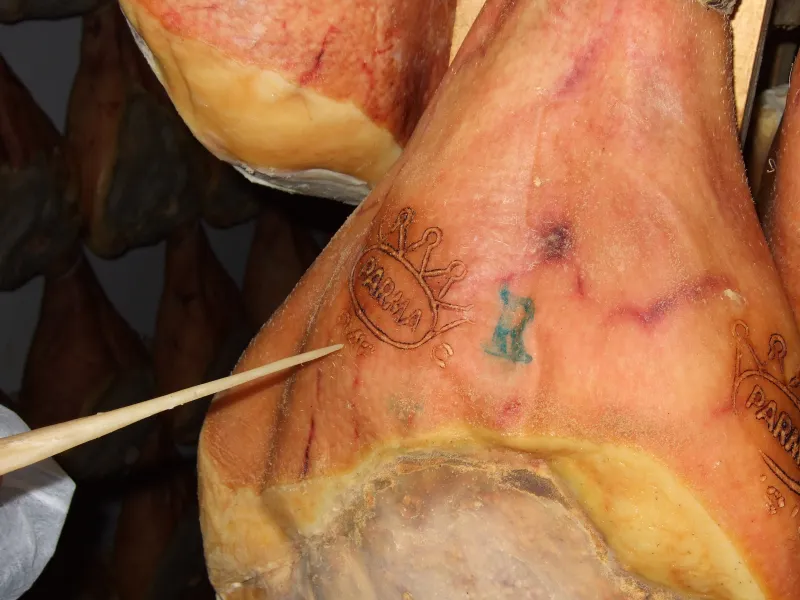
Prosciutto di Parma pork leg and sea salt, aged at least twelve months
Only Italian pork and sea salt, aged for at least twelve months: Prosciutto di Parma has held Protected Designation of Origin status since 1996.
Read more →The name has nothing to do with cats, and nobody really knows where it comes from. The three explanations scholars propose pull in different directions: from the Latin figulinus, the man who works clay for pots and bricks, in memory of the old kilns; or from Filinum, after a Roman family granted these lands; or else from the Greek phylàtto, «I guard», for a supposed Byzantine post. The first reading has had a small confirmation from the ground: the Roman villa found in 1981 during works in the artisan quarter had a kiln of its own. The first certain document dates from 948, when Lothair, king of Italy, granted the count of Parma the rights over the curtis Filinum and fifteen others; the castle is securely attested from 1140, and in 1186 Frederick Barbarossa assigned the fief to Guido de' Ruggeri of Parma in gratitude for the loyalty he had shown.
From then on the village and its castle had opposite fortunes. By a patient marriage policy the Rossi married the de' Ruggeri heiresses for two generations and gathered in the fief in 1346; Felino, lying at the exact centre of their domains, became the most populous of the Rossi holdings and, for more than a century, the seat of the seigniorial chancery. That made it a target: the town was sacked and burned in 1325, then again in 1403, and once more in 1404, in 1405, in 1408 and the year after, while the castle, defended each time, did not fall. Today that same castle houses the museum of the salame that bears the town's name.
Only Italian pork and sea salt, aged for at least twelve months: Prosciutto di Parma has held Protected Designation of Origin status since 1996.
Read more →Straight-line distances from the town centre. Tap a point to open its page.
The closest destinations covered by our editors, with straight-line distance.


