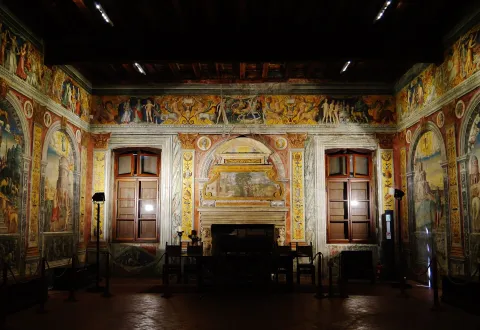
Beginning in 1308 as the residence of the Bonacolsi family before becoming the seat of the Gonzaga dynasty, the Ducal Palace of Mantua evolved into a vast "city-palace" spanning more than 35,000 square metres. Containing over 500 rooms, 7 gardens, and 8 courtyards, it stands among the largest royal residences in Europe. Its unified plan dates to 1556, when Duke Guglielmo appointed architect Giovan Battista Bertani to connect a series of independent structures built since the 13th century between Piazza Sordello and Lago Inferiore, a project later completed by Bernardino Facciotto.
What to see
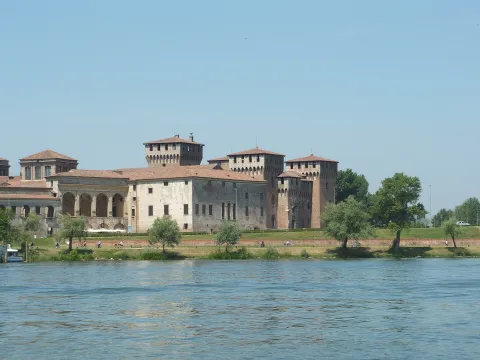
The monumental complex divides into four main sectors. Corte Vecchia, the oldest section facing Piazza Sordello, features the Magna Domus and the late 13th-century Palazzo del Capitano built by Guido Bonacolsi. Enlarged in the 14th century with a porticoed facade, it houses the 67-metre-long Salone dell'Armeria, venue of the 1459 Diet of Mantua. In the Pisanello Room, visitors can examine Antonio Pisano's Arthurian chivalric frescoes (1433–1437) depicting the Battle of Louverzep, commissioned by Gianfrancesco Gonzaga. The other areas comprise the Domus Nova by Luca Fancelli, the lakeside Corte Nuova designed by Giulio Romano and expanded by Bertani and Viani, and the Palatine Basilica of Santa Barbara. Within the Castello di San Giorgio lies Andrea Mantegna's famous Camera degli Sposi, alongside the Romano Freddi collection featuring a panel by Giulio Romano and a fragment of Rubens's altarpiece of the Gonzaga family.
Visiting
Established as a national museum following a 1915 agreement, the palace endured centuries of hardship. repurposed for military use under Austrian rule—when the Castello di San Giorgio served as a prison for Italian patriots—and stripped of original treasures following Duke Ferdinando's sales to King Charles I of England and the 1630 Sack of Mantua, the museum displays works recovered from Mirandola in 1716 and several 20th-century bequests. Following structural damage caused by the 2012 earthquakes, the Castello di San Giorgio and Mantegna's Camera degli Sposi officially reopened to the public in April 2015.
Our editors' tip
When walking through Corte Vecchia, spend time observing Pisanello's Arthurian fresco cycle: painted between 1433 and 1437, it provides an exceptional record of chivalric court culture under Gianfrancesco Gonzaga.