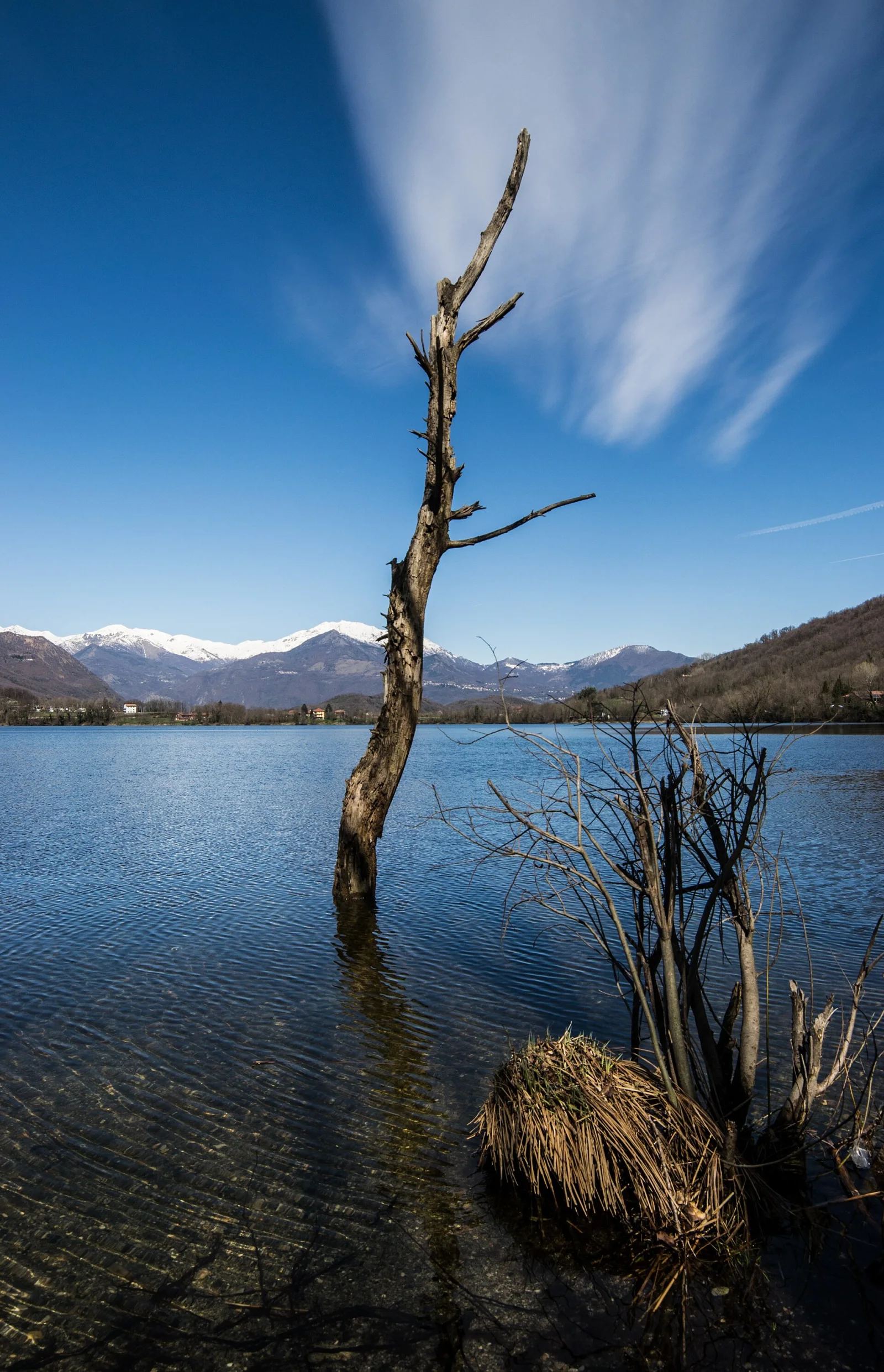
The park protects the two lakes of Avigliana and the Mareschi marsh, in the lower Susa valley, inside a morainic amphitheatre bounded on this side by Monte Pirchiriano and the hill of Rivoli. It was set up in 1980 to safeguard the local ecosystem and to slow down building pressure, which here, half an hour from Turin, never lets up.
What to see
The Mareschi are the westernmost marshland in Italy. They lie in the almost flat stretch crossed by the Naviglia canal, the only outlet of the two lakes towards the Dora Riparia; in the past the current would occasionally reverse, depending on the level of the Lago Grande and the flow of the Dora. The flora is that of wetlands and so is the fauna: grey herons, coots, mallards, grebes, cormorants, moorhens, frogs and pheasants. In the water there are pike, carp, perch and largemouth bass.
Visiting
Two disused factories also stand inside the park boundary, and they are the surprise. One is the Nobel dynamite works, now a museum. The other housed the Duco-Montecatini paint factory, where Primo Levi worked immediately after the war: at that desk he wrote much of If This Is a Man. The park also runs environmental education with schools and monitors mosquitoes in the surrounding comuni, which with a marsh on the doorstep is no small matter.
Our editors' tip
The circuit of the lakes can be walked or cycled and half a day covers it. If you have time, extend it to the Mareschi, the least frequented part and the one where you see most birds. And anyone arriving with children should start at the dynamite works: the idea that explosive was made here, among the reeds, lands better than any information panel.