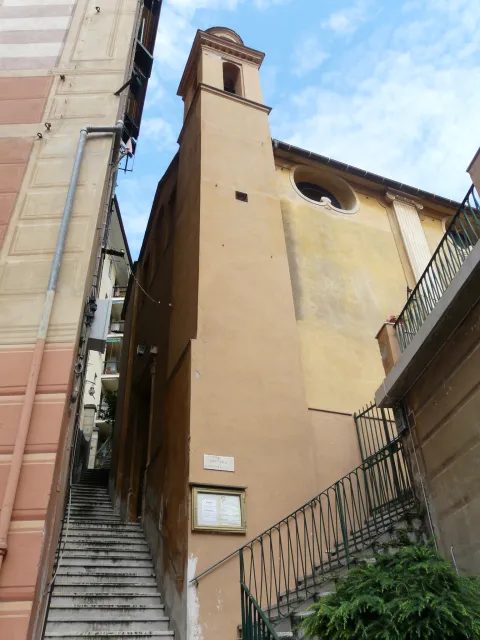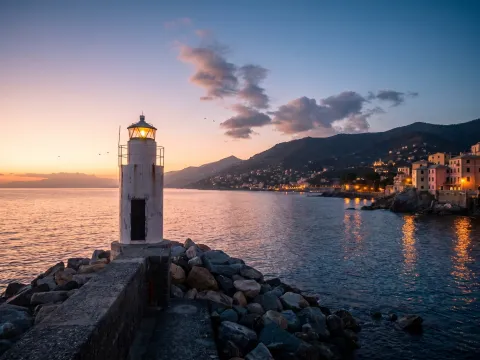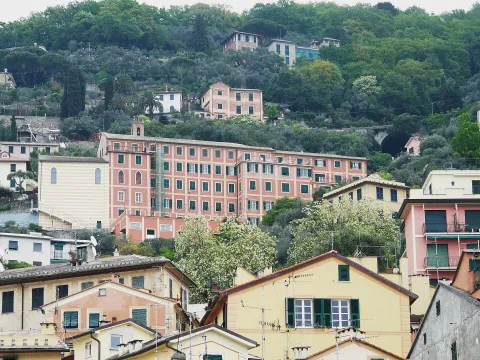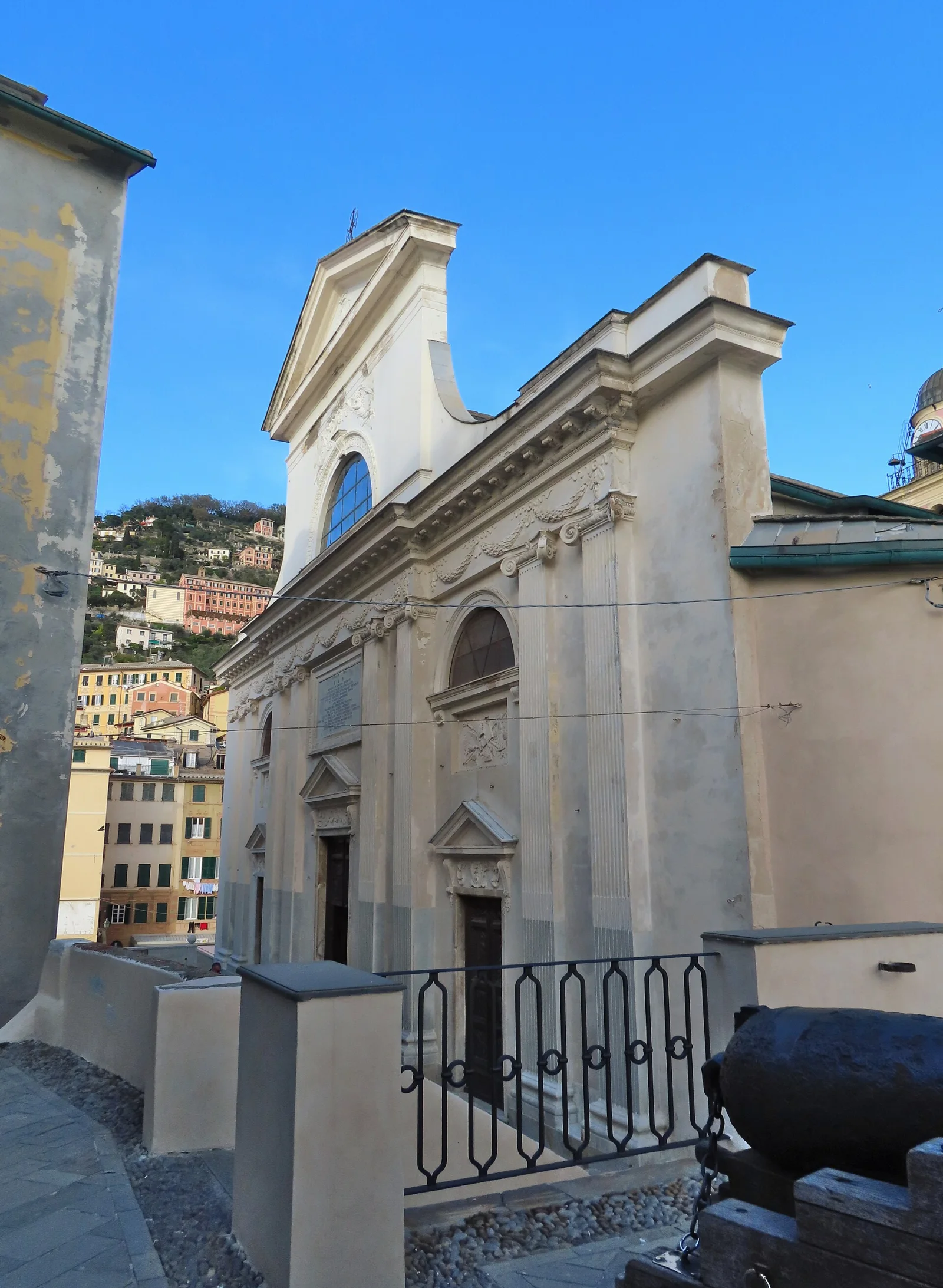
Camogli's parish church is built on a rock: according to local historical sources it went up in the 12th century on a small island right beside the fishing harbour, and one side of the building still faces the water, behind the tall painted houses of the village. Enlargements in the 16th century and in the early decades of the 19th changed its shape; the archbishop of Genoa, Luigi Lambruschini, consecrated it in 1826, monsignor Placido Maria Tadini consecrated it again in 1847, and in November 1988 John Paul II gave it the title of minor basilica.
What to see
Inside there are three baroque naves, faced with gilded stucco and polychrome marble, with crystal chandeliers and a baptistery clad in the same marbles: after the plain façade the effect arrives all at once. The vault carries late 19th-century frescoes by Nicolò Barabino and Francesco Semino. The high altar is the work of the sculptor Andrea Casareggio and holds the Assumption, a baroque wooden statue by the Camogli-born Francesco Maria Schiaffino; the wooden choir is 18th century, and the sacristy keeps a Deposition by Luca Cambiaso.
The chapels deserve a slow circuit. On the right, the Madonna of the Rosary with Saint Dominic and Saint Catherine, again by Schiaffino, and the marble altar of Saint Prosper, dated 1788, which holds a 16th-century reliquary. On the left, Bernardo Castello's altarpiece of the Miraculous Draught of Fishes, a Virgin and Child by Domenico Fiasella, a Saint Erasmus by Giuseppe Badaracco and a Saint Anthony of Padua by Guido Galletti, the same sculptor who modelled the Christ of the Abyss sunk offshore. In the three niches of the façade, since 1970, stand Saints Prosper and Fortunatus with Our Lady of the Boschetto.
Visiting
The entrance is on via dell'Isola, at the far end of the old village above the harbour: from the railway station it is a walk of a few minutes downhill, and the lower part of Camogli is covered on foot only. This is a working parish church, in the Recco-Uscio-Camogli vicariate, so its hours follow the services and the time around mass stays the safest for finding it open.
Our editors' tip
Look at it from outside first, from the harbour mole: from there you understand that it sits on the rock, its wall almost flush with the water, something you lose completely once inside. Then go in and find Galletti's Saint Anthony: seeing this statue and the Christ on the seabed on the same day, both from the same hands, is the best way to spend time in Camogli.