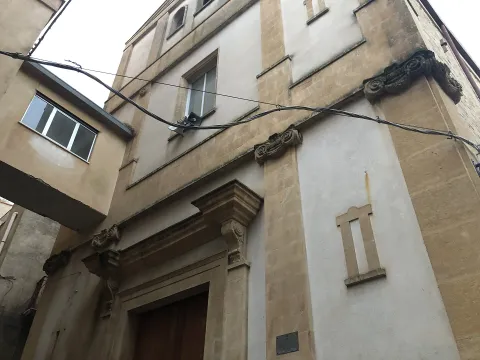
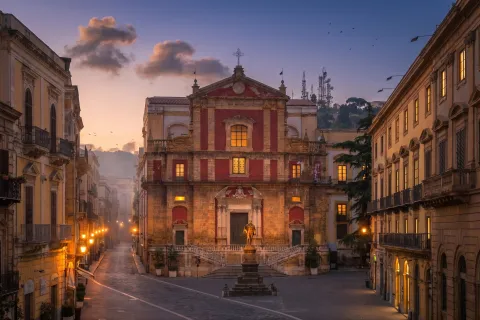
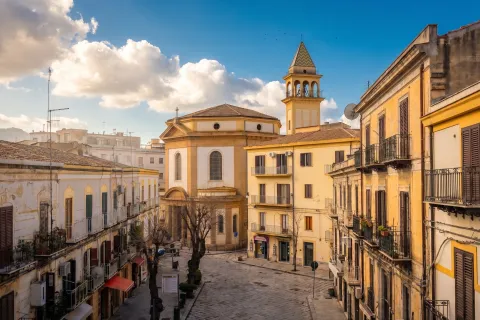
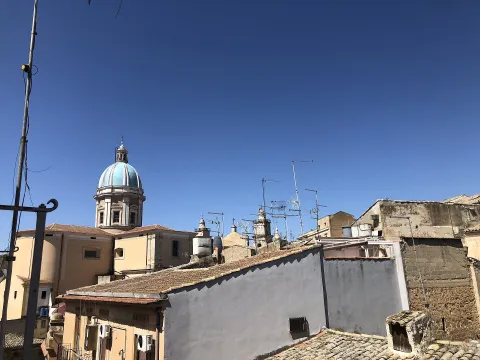
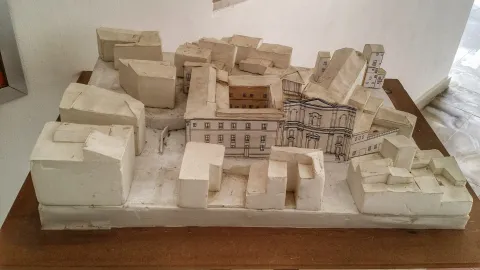
Consecrated in 1153 — a date preserved on a commemorative plaque set into the left pillar of the main apse — the Abbey of the Holy Spirit was the first parish church of Caltanissetta. It was commissioned by the Norman Count Roger and his wife Adelasia; in 1178 it passed to the Augustinian canons regular, and the recorded line of abbots began only in 1361. The complex stands on the northeastern edge of the city, along the state road, opposite the regional archaeological museum.
What to see
The church is a single nave closed by three apses, its length three times its width. The three small apse windows are set so their axes converge on a single point, a deliberate nod to the mystery of the Trinity, echoed by three more openings above the presbytery. Outside, the side portal and the apses with their flat pilaster strips — the buttresses that once carried conical roofs — follow the models of early Norman building. The tall, semicircular convex apses remain the clearest trace of the original Romanesque plan, while the entrance sits on the north side, through a rounded portal. Inside, the Norman baptismal font survives alongside a group of 15th-century frescoes: the Mass of Saint Gregory, showing Christ rising from the sarcophagus among the instruments of the Passion; a blessing Christ; and fragments of a Saint Augustine. The Pantocrator was repainted in 1964 by the Catania painter Archimede Cirinnà. The 16th-century polychrome terracotta statue of the Madonna delle Grazie is the oldest image of the Virgin in the city, and the Crocifisso dello Staglio, painted in tempera on panel, is held to be the abbey's most valuable work.
Visiting
The choir loft was built in 1877 and carries the coats of arms of Bishop Giovanni Guttadauro and the abbot of the day. The main altar, the Protesis and the Diaconicon were each cut from large blocks of Sabucina stone. Among the furnishings, look for the 1st-century Roman cinerary urn that belonged to Diadumenus, a freedman of the emperor Titus who most likely owned the land where the abbey later rose. The present library began as an Arab farmhouse, later absorbed into the Norman structure.
Our editors' tip
The abbey lies outside the old town, on the road toward Enna, so pair it with the regional archaeological museum across the way: seen together, Diadumenus' urn and the local finds make far more sense. Ask to look closely at the Crocifisso dello Staglio and the baptismal font — the two pieces that best tell the church's double story, Norman and devotional.