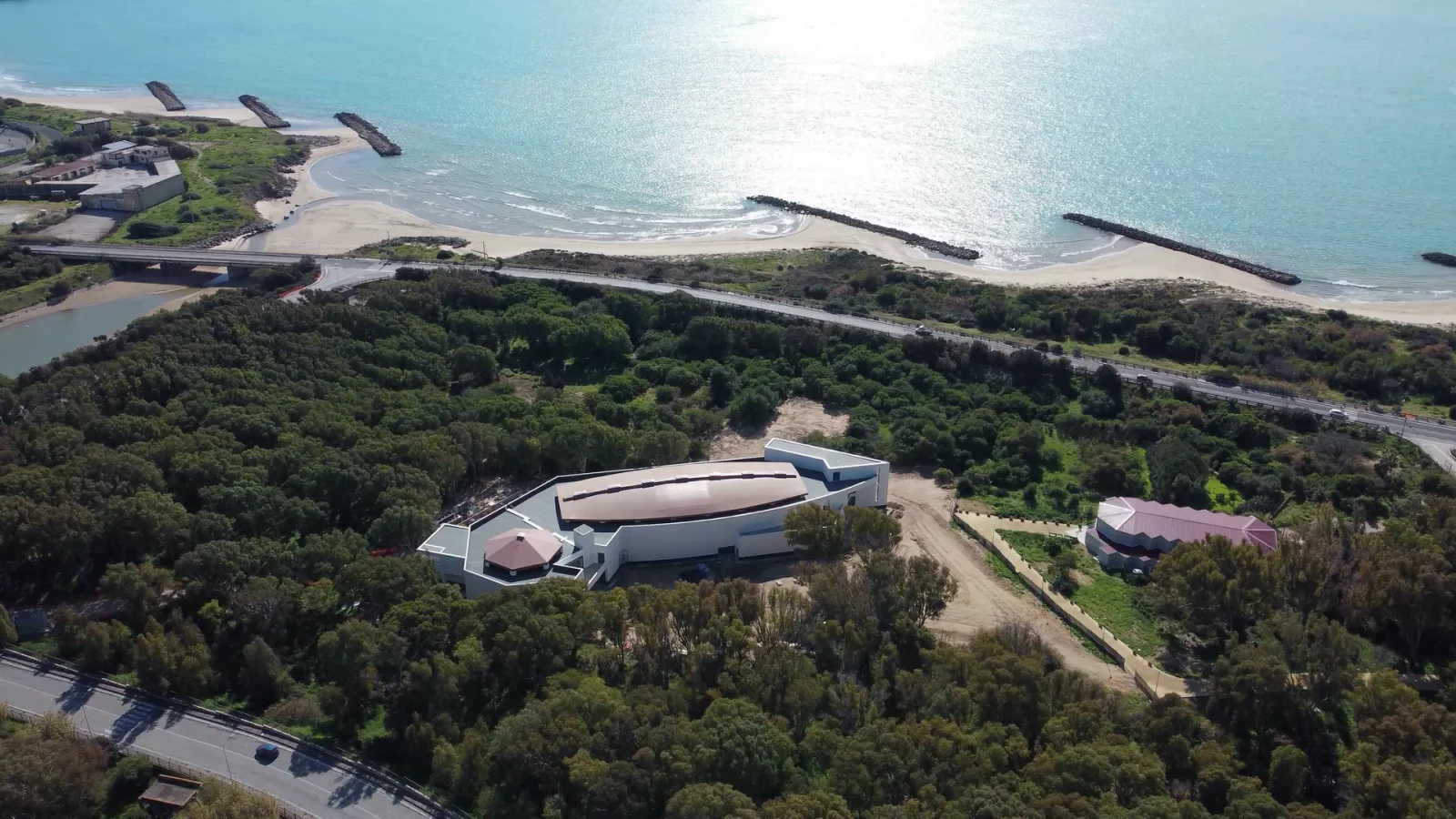
The Museo dei Relitti Greci (Greek Shipwreck Museum) is in Gela, in the archaeological area of Bosco Littorio. Born as an extension of the regional archaeological museum, it houses the wrecks of Greek ships found on the seabed of the gulf of Gela, together with their original cargo.
What to see
In the main hall, after an octagonal atrium that serves as ticket office, refreshment point and bookshop, the wreck «Gela I» stands at the centre, with its long keelson, floor timbers and part of the planking. Around it, in display cases, are the finds from the cargo: wine and oil amphorae, Attic pottery, lamps, cups, bowls and everyday objects from life on board, among them a clay whistle, two terracotta arulae (small altars), a statuette of a seated female deity and a clay piglet. Other cases are devoted to «Gela II», which was under restoration at the opening, and to other finds of the Soprintendenza del Mare, including a Corinthian helmet and several orichalcum ingots of the sixth century BC.
The hall also holds an immersive room by Studio Azzurro: small and soundproofed, it has six lightboxes of engraved copper which, when touched, activate interactive projections of moments in the ship's voyage, inspired by the objects on display. A stairway leads to a gallery that runs around the hall, with a view of the ship from above, and then to the first floor, where there are augmented-reality stations with VR headsets. The building, with 4000 square metres of exhibition space, was designed by the architect Ettore di Mauro with a broad glulam roof that recalls the overturned hull of a boat.
Visiting
The museum was inaugurated on 24 February 2026, after works begun in 2021 and completed in 2024 with the final inspection; the installation of «Gela I» had started in April 2025. Since it is newly opened, the display may change: hours, tickets and what is on show should be checked with the Soprintendenza or the Comune before going.
Our editors' tip
The museum stands at the mouth of the river Gela, where the port of the ancient city probably lay and where these very ships docked: this is why it was built here, beside the archaic emporium of Bosco Littorio.


