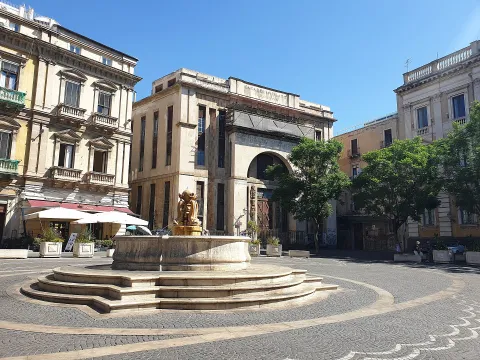
In the west wing of this square there is a piece of Roman amphitheatre, and it lies about ten metres below street level. It has not sunk: it is the walking level of the city that has risen, one eruption and one earthquake at a time, for two thousand years. Those ten metres are the most honest measure of what Catania is.
What to see
Piazza Stesicoro is rectangular and stands on via Etnea, north-west of the San Berillo quarter. It is bounded to the north by palazzo Tezzano and palazzo del Toscano; to the east by palazzo Beneventano and a building of the late fifties; to the west by the church of San Biagio and the palazzo della Borsa, inaugurated in the early thirties as the seat of the corporative organisations of the time and today occupied by the chamber of commerce; to the south by some nineteenth-century buildings, among them palazzo Bicocca. In the east wing stands the monument to Vincenzo Bellini. The portion of amphitheatre was brought to light in 1903 and opened to the public in 1907.
Behind the Bellini monument the square opens onto corso Sicilia, a modern street more than twenty metres wide. It came out of the gutting of San Berillo, that is the partial demolition of that historic quarter, carried out from May 1956 through the two following years. The operation was justified by the need to connect via Etnea to the railway station, an aim in fact achieved only thanks to a second street; the corso is flanked by new buildings intended above all for banks and insurance companies. It is useful to know this while standing in the square: on one side you look down towards the first century, on the other you look straight at the place where a quarter was removed. Stesicoro is in any case one of the busiest squares in the city, partly because it adjoins the Fera 'o Luni, Catania's oldest market, which stays open all week.
Visiting
The square is public and crossed at any hour. The archaeological area of the amphitheatre, on the other hand, has its own hours and arrangements, which change over time and should be checked beforehand. Since 2016 there has been a metro stop here. Half an hour for the square, more if you go down to the amphitheatre or if you happen on market hours, which are the liveliest thing in the quarter.
Our editors' tip
Lean over the railing above the amphitheatre and do not look at the ruins: look at the wall of earth and masonry in front of you, the one between the level of the Roman arches and the tips of your shoes. Try estimating it: ten metres, three floors of a house. Then go back up to via Etnea and continue your walk knowing that you are walking on that thickness, wherever you go in this city. It is the most effective way to understand why in Catania the ancient remains always turn up underneath something else, and why to see them you almost always have to go down.