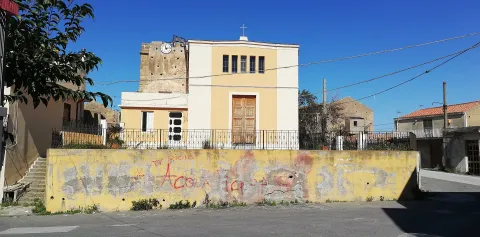
The Duomo of Santa Maria Assunta stands in the heart of old Pozzo di Gotto, on the site of the old duomo. The first church was founded in 1620 by the parish priest Matteo Valveri, under Archbishop Andrea Mastrillo, and completed in 1646; the southern Calabria earthquake of 1783 destroyed it. Rebuilt between 1859 and 1863, it then took the title of mother church of Pozzo di Gotto, taken from the nearby church of San Vito; the 1908 Messina earthquake damaged it so badly that it was pulled down and rebuilt in its present form, completed in 1938.
What to see
The church is a Latin cross with three naves divided by sturdy piers. In the rooms along the outer sides are fragments of friezes, capitals, corbels and columns that survived the earthquakes. On the entrance wall are Michele Panebianco's Saint Liberante of 1861 and Salvatore Ferro's Coronation of the Virgin of 1859; in the first bay on the right is the Holy Family with the young Saint John by fra Feliciano da Messina, known as the «Raphael of the Capuchins», from 1666.
In the left aisle, on the altar of Saint Vitus, stands the saint's marble statue from the workshop of Rinaldo Bonanno, from the second half of the sixteenth century, brought from the old duomo of San Vito; from the same church comes the gilded seventeenth-century wooden ciborium in the chapel of the Blessed Sacrament. In the transept is the Madonna of the Rosary by Placido Lucà Trombetta, from 1869. On the floor of the first bay on the left rests a bell that survived the earthquake.
Visiting
The church was home to the old confraternity of San Filippo d'Agira, founded around 1620. Mass times should be checked with the parish.
Our editors' tip
In the second bay on the right is the vara of the Crucifixion, a group in cypress wood by Giuseppe Rossitto from 1870, with papier-mâché figures added in 1978: it is the float that the confraternity of the Blessed Sacrament carries in procession during Holy Week.