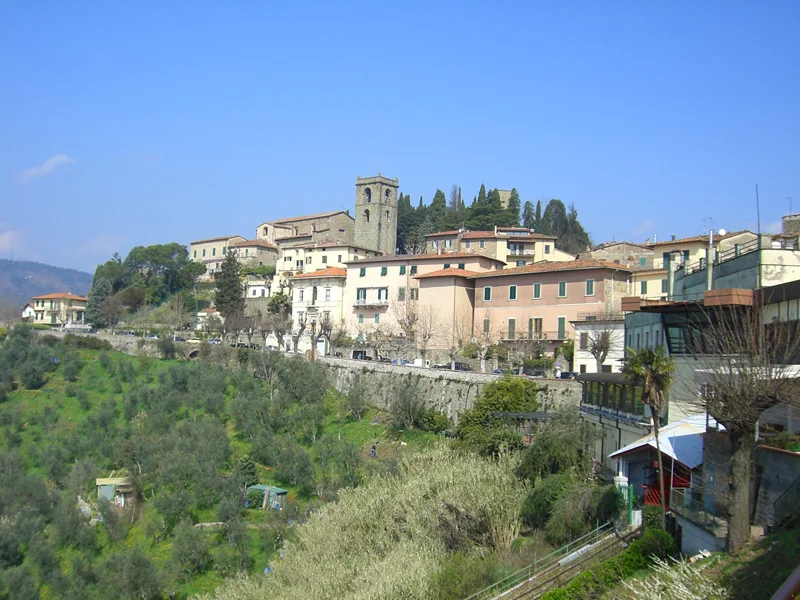
The original settlement was called Vivinaia, an old property of the dukes of Tuscia, and lay at the foot of the hill. In 1331 the Florentines devastated it, and the authorities of Lucca decided to refound the village on top of the Cerruglio hill, where the fortress already stood. In 1333 the new village took the name of Montecarlo in honour of the future emperor Charles IV of Luxembourg, who had helped Lucca to free itself from Pisan occupation: Charles's mountain, and it has nothing to do with the principality by the sea. Since 2002 the village has been twinned with Karlštejn, in Bohemia, that is with the castle Charles IV had built for himself. The fortress of the Cerruglio counted for a good deal in the fourteenth-century wars between Lucca, Pisa and Florence: it was from that rock that in 1325 Castruccio Castracani directed the troops that won at Altopascio. It was enlarged first by Paolo Guinigi, lord of Lucca, then by the Florentines, who from 1437 held Montecarlo for good.
Inside the walls is the theatre of the Rassicurati, one of those small eighteenth-century theatres that in Tuscan villages turn up where you least expect them. The collegiate church of Sant'Andrea, begun in the fourteenth century and remade in 1783, is the tallest building in the village and keeps its Romanesque crypt; at the foot of the hill the pieve of San Piero in Campo has one of the oldest bell towers in the whole diocese of Lucca and is what remains of a medieval village destroyed in one of the many wars fought in these parts. The hill today is planted with vines and olives: here they make the Montecarlo bianco and the rosso di Montecarlo and an oil with a denomination, and since 1999 the wine and oil road of Lucca, Montecarlo and Versilia passes through. The village sits astride the Lucchesia, all irrigated and sown with maize, and the Valdinievole, dotted with greenhouses for flowers.
Straight-line distances from the town centre. Tap a point to open its page.
Near Montecarlo
The closest destinations covered by our editors, with straight-line distance.


Places to see within 25 km
Outside Montecarlo, but an easy day trip away.