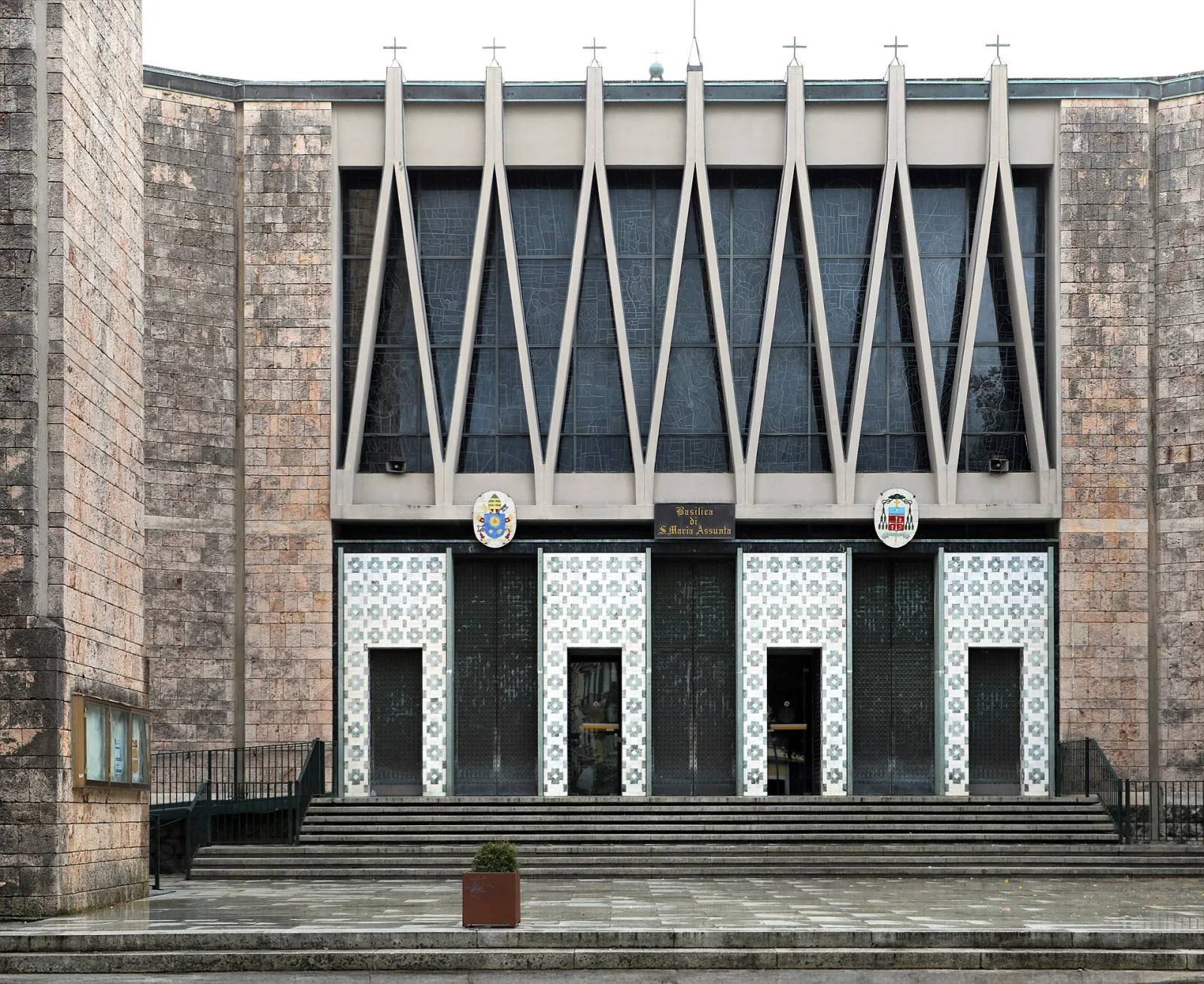
In November 1988, Pope John Paul II elevated the church of Santa Maria Assunta in Montecatini Terme to the status of a minor basilica. Located in the province of Pistoia within the Diocese of Pescia, the modern building was erected between 1953 and 1958 based on a design by Raffaello Fagnoni in collaboration with Pierluigi Spadolini, Mario Negri, and Alfonso Stocchetti. Its construction required the demolition of a 1833 neoclassical church built by Luigi de Cambray Digny.
What to see
The basilica features an octagonal layout anchored by a reinforced concrete structure finished in travertine cladding, set beside a slender bell tower. Inside, four side chapels frame the presbytery, which is capped by a lantern dome with a shell-like vaulting. Notable internal elements include the stained glass windows designed by painter Giorgio Scalco and the Crucifix behind the presbytery, sculpted by Florentine artist Sauro Cavallini. Of the demolished 1833 structure — which originally possessed an Ionic porch and a semicircular window inspired by ancient thermal baths — the surviving pronaos remains visible today in the park of Villa Forini Lippi, saved through a joint project between the Lions Club and the local municipality led by Mayor Ettore Severi.
Our editors' tip
To discover what remains of the original 19th-century church, head to the park of Villa Forini Lippi to see the preserved neoclassical pronaos salvaged prior to the 1950s rebuilding.