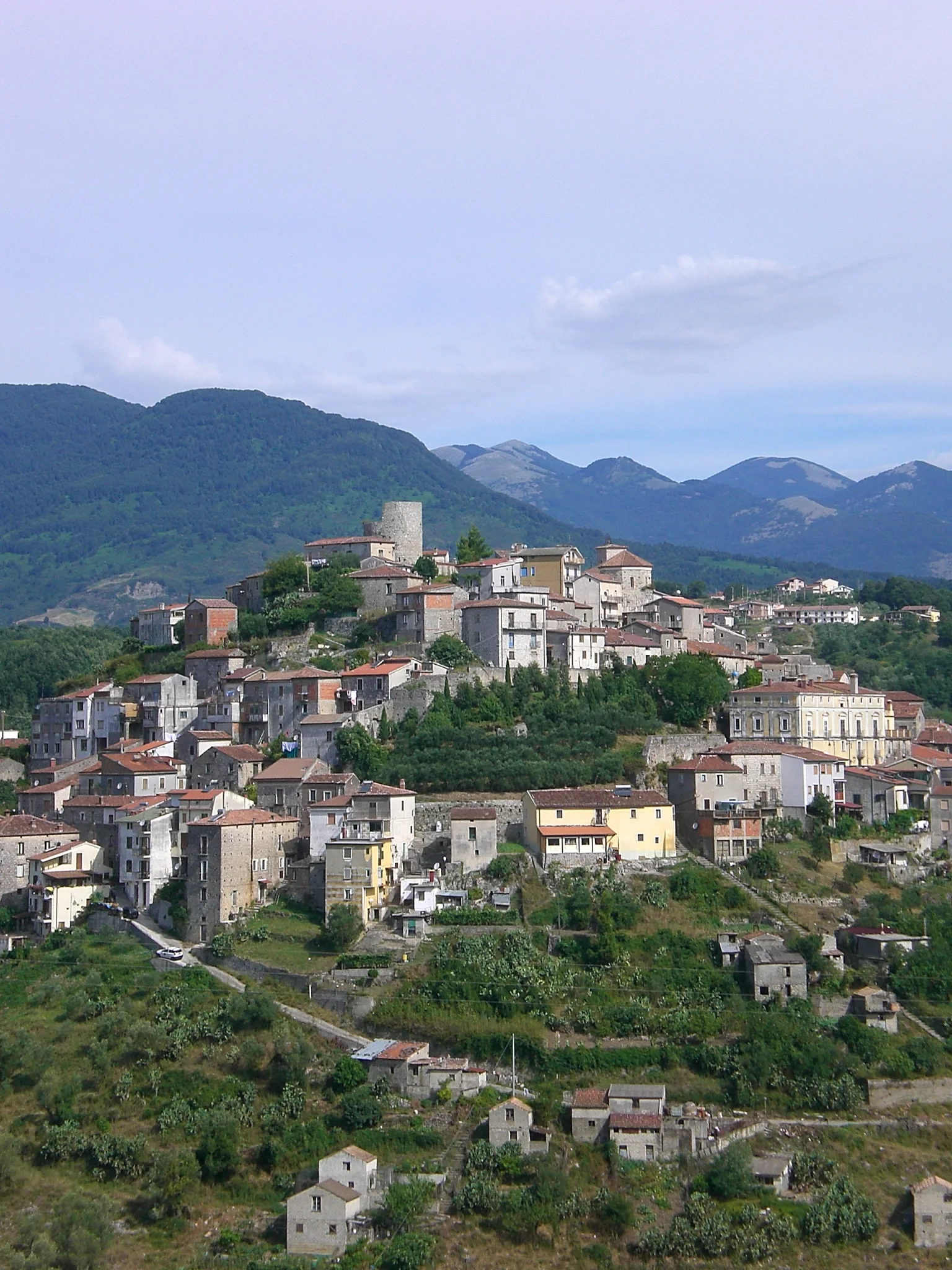
From the village you look at Monte Cervati, from whose summits the Bussento is born. The river crosses the territory of Caselle as far as lake Sabetta and then, at a place called La Rupe, just east of the houses, is swallowed into the bowels of the earth. The town sits perched on a hill beneath a medieval tower and takes half its name from stony Monte Pittari, where the sanctuary of Saint Michael the Archangel stands. The cult of the archangel arrived here in the seventh century with the Byzantine monks; in the cave of San Michele prehistoric pottery has been found; and at the beginning of the eleventh century the Lombard prince of Salerno, Guaimario III, founded on that mountain the abbey of Sant'Angelo, whose remains can still be seen beneath the complex of crypts.
The first mention of Caselle sits inside a piece of news about somebody else: the pastoral letter of 1067 with which the archbishop of Salerno announced to his clergy that the abbot of Cava had been made bishop of the re-established diocese of Policastro. Then comes the Catalogus Baronum, then the Sanseverino, one of whom, Guglielmo, took part in the Conspiracy of the Barons in 1485, lost every fief he had and saw them all given back eleven years later. In 1570 Pietro De Stefano bought Caselle for eleven thousand five hundred ducats, and his family held it until 1674, when the last De Stefano had to sell it to a judge to cover debts he could not pay. The source explains the mechanism as well: famines, an excessive tax burden and epidemics were cutting the nobles' income, and the nobles borrowed. The fief then passed to the Cristiani, on the thirteenth of June 1764 went to a daughter, Chiara, and ended with the Mazzarotta until the abolition of the feudal laws.