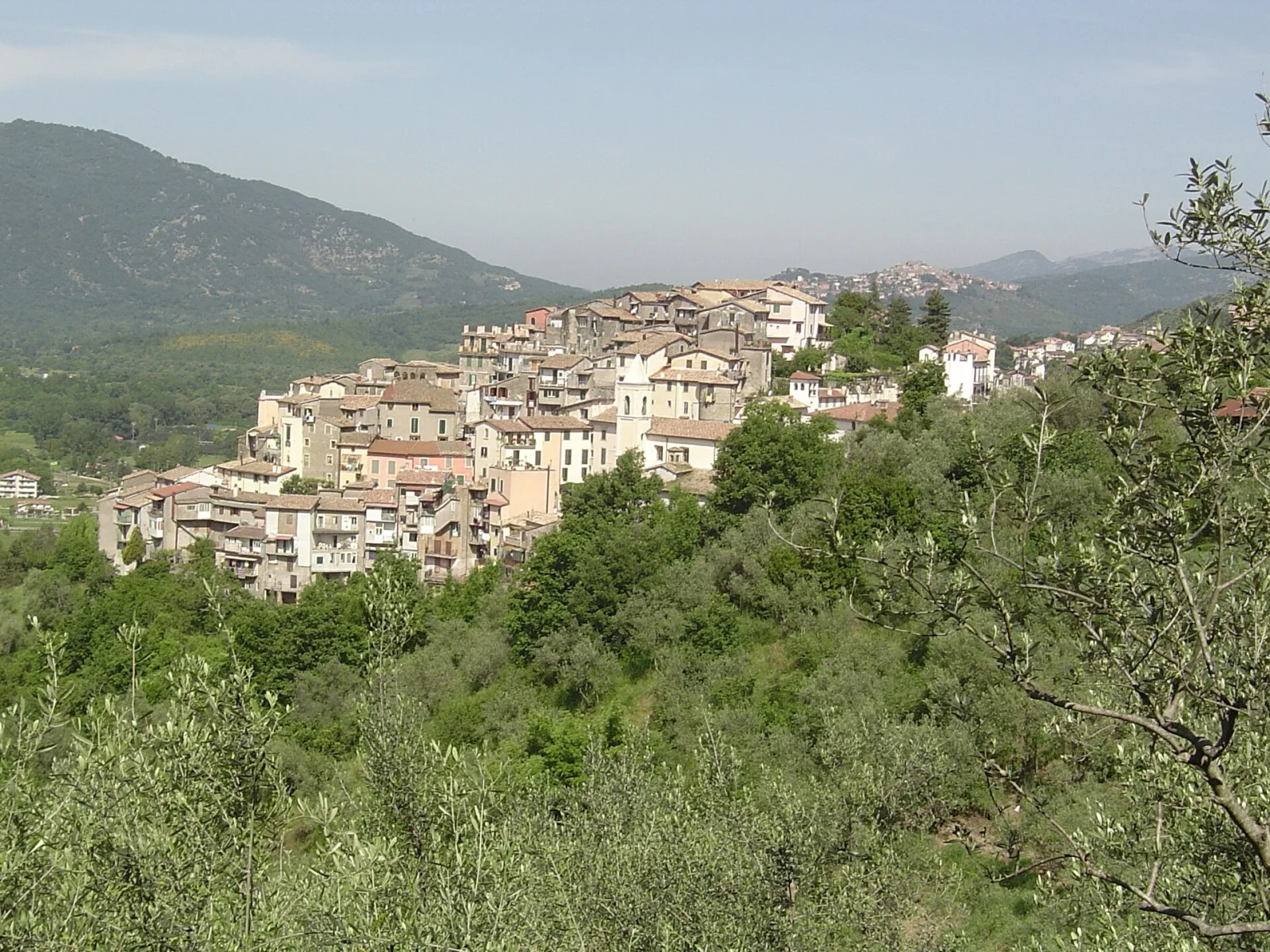
The infiorata of Gerano is held to be the oldest in Italy. It is made every year on the first Sunday after Saint Mark's, that is after 25 April, in honour of the Madonna del Cuore, and tradition ties it to a painting of 1727 by Sebastiano Conca of Gaeta, believed to be miraculous; to compose the designs only flower petals and leaves are used, nothing else. In the village there is even a museum devoted to the infiorata, next to another that gathers old tin boxes. The other feast is that of Sant'Anatolia, held since 1838 on 9 and 10 July on the meadow in front of her little church: it is a nundina, that is a fair of livestock and produce of the land, and that meadow has served this purpose since the fifth century. Saint Anatolia is also the patron of gypsies, and the feast still draws Roma communities from all over Italy.
The village stands on a tuff hill at five hundred and two metres, in the Monti Ruffi. Nobody knows when it was born, but in 1005 it was already a castrum, and it counted enough to interest the popes: in 1077 a brief of Gregory VII confirms it divided between the diocese of Tivoli and the abbot of Subiaco. It was the chief town of the Massa Giovenzana, having taken the place of the older Trellanum. The church of Sant'Anatolia, born as a curtis dominica in the sixth century, is the oldest in the whole valley of the Giovenzano. There are then three Roman fountains that still run: the Fontana Vecchia is of the first century, those of Ciocio and of Leo of the second. At the first census, in 1640, Gerano had six hundred and fifty-six inhabitants in a hundred and forty families; it reached its peak in 1948, coming close to two thousand.
Straight-line distances from the town centre. Tap a point to open its page.
Near Gerano
The closest destinations covered by our editors, with straight-line distance.


Places to see within 25 km
Outside Gerano, but an easy day trip away.