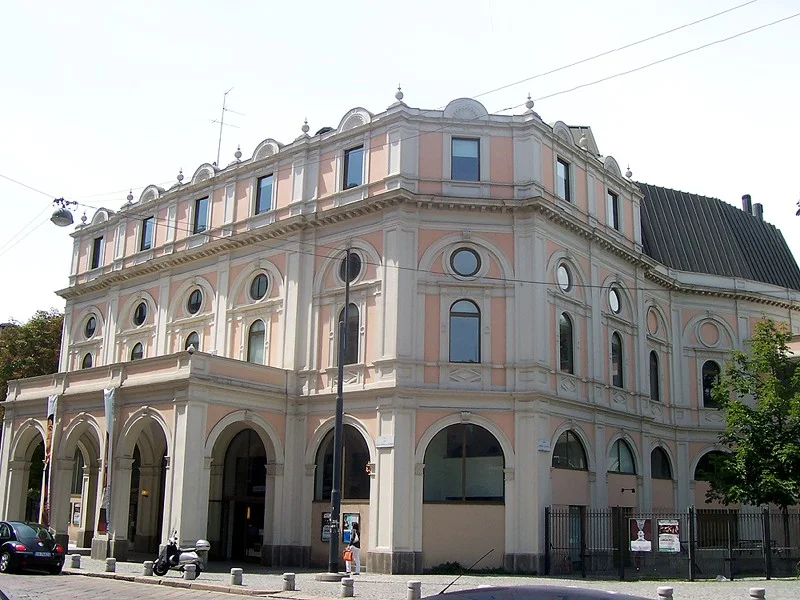
It was born to silence the tenants: in the eighteen-sixties there was a circus-theatre here where the horseman Ciniselli performed, with a noisy audience that disturbed the neighbourhood, and Count Francesco Dal Verme, who owned the houses around, bought the land and had a real theatre built. Giuseppe Pestagalli designed it with three thousand seats, the horseshoe shape of opera houses and a gallery holding fourteen hundred on its own; it opened on the fourteenth of September 1872 with Meyerbeer's Huguenots. It was the theatre of debuts: here Puccini presented Le Villi in 1884, his first opera, and here Leoncavallo staged Pagliacci in 1892, conducted by a twenty-five-year-old Toscanini.
What to see
Of the nineteenth-century theatre only the façade on Via San Giovanni sul Muro remains, because the American bombs of 1943 took away the rest; rebuilt in 1946 as a cinema and remade at the end of the nineteen-nineties, it reopened in 2001 as a concert hall, with fifteen hundred seats, a small hall of two hundred and a space for exhibitions. The main hall, modern and with acoustics designed for symphonic music, is home to the Pomeriggi Musicali orchestra, which since the post-war years has brought classical music to an audience of Milanese subscribers.
The programme is the reason to go in: symphonic and chamber music all season, jazz, rock, cinema, and in summer the evenings of the Milanesiana, the festival that brings together writers, philosophers and musicians. In this theatre, in the nineteenth century, the first Italian Greco-Roman wrestling championship and a world weightlifting championship were also held, and Marinetti brought here the evenings of futurist theatre, which regularly ended in whistles and vegetables.
Visiting
The theatre is on Via San Giovanni sul Muro, between the Sforza Castle and the Duomo, Cairoli or Cordusio metro; it cannot be visited by day, you go in for concerts, with tickets often at low prices and subscriptions for the Pomeriggi Musicali, traditionally held on Thursdays and Saturdays. An evening. The foyer bar opens before the performances.
Our editors' tip
Go to a Saturday musical afternoon, which costs little and has the usual audience, people who have been coming here with a subscription for forty years: it is the most Milanese way to listen to classical music, without gala evenings and without good clothes. And at the entrance, think that on this stage a young man called Toscanini conducted Pagliacci when nobody yet knew who he was.


