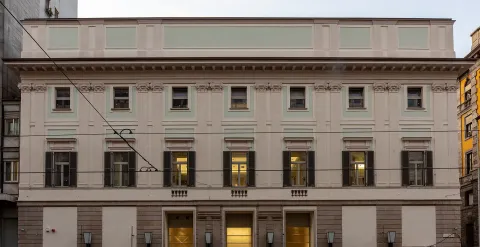
For one season a private theatre on corso di Porta Romana beat La Scala. Between the winter of 1830 and the following spring, the stage of the Carcano saw two first performances that would stay in the repertoire for ever: Donizetti's Anna Bolena and, ten weeks later, in 1831, Bellini's La sonnambula, with Giuditta Pasta singing both. The theatre had opened in 1803, built by Giuseppe Carcano, a private citizen who decided to put up an enormous hall where Milan was growing, and for a year the gamble paid off beyond anything he could have expected.
What to see
The Carcano is still one of the largest halls in the city and works all year with drama, dance and music. The original building was designed by Luigi Canonica, the architect of public spaces in Napoleonic Milan, and it went up on an avenue only just relaid by Piermarini, with new paving and granite pavements. In the twentieth century the hall went through everything, including the decades when it was a cinema, and what you see today is the result of successive rebuildings.
It is not a museum theatre and there are no guided visits: you go in because there is a show. But it is one of the few places in Milan where today's audience sits where the audience sat that first heard Amina's farewell aria, and for anyone who loves opera that is no small detail.
Visiting
The theatre is on corso di Porta Romana, ten minutes on foot from the Duomo and two from the Crocetta metro stop. The season runs from autumn to spring, with a box office on site and prices modest compared with the great houses; outside performances the building is closed. An evening.
Our editors' tip
If you want to see it, the only way is to buy a ticket, and a midweek play is the thing to choose: it costs little and the hall is less full, so you can take a good look before the lights go down. On the way out, walk a hundred metres along the avenue: the granite pavements you are walking on are the idea of a city that was in the mind of the people who built this theatre.