Cattedrale di Sant'Emidio ★
The Roman forum basilica turned cathedral, and Crivelli's polyptych still in its place.

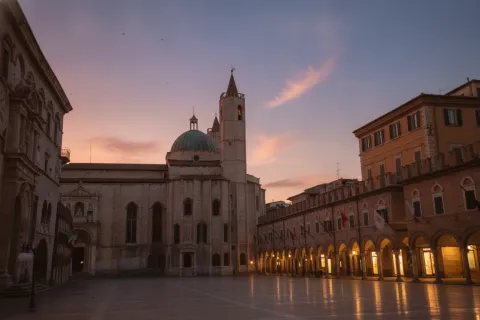
 Squares Ascoli's Piazza del Popolo A Renaissance square defined by local travertine, home to the Gothic church of San Francesco and a 16th-century loggia.
 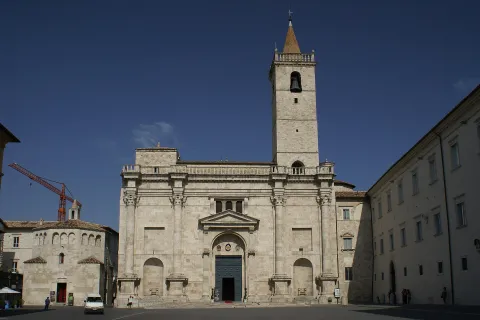 Churches Cattedrale di Sant'Emidio The Roman forum basilica turned cathedral, and Crivelli's polyptych still in its place.
 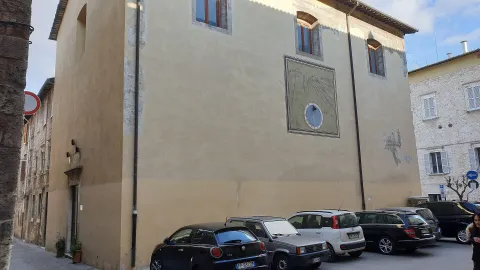 Churches Chiesa di San Cristoforo Ascoli's church of the Good Death, with Callido's oldest surviving organ.
  Churches Chiesa di San Francesco Ascoli's Franciscan church, with musical columns beside the doorway.
 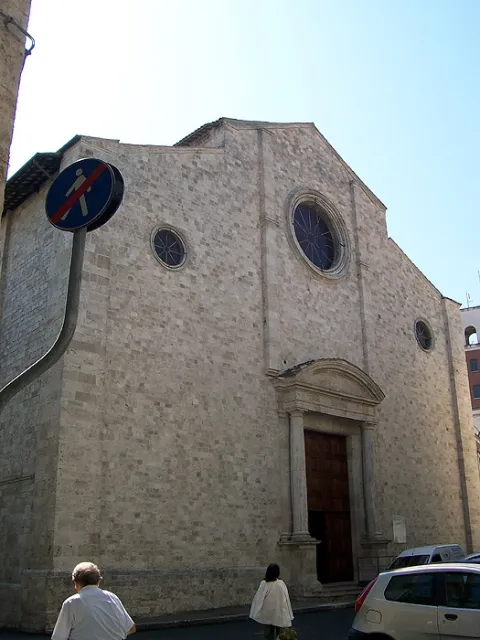 Churches Chiesa di San Pietro martire Ascoli's Dominican gothic church, grown by swallowing the noble towers.
 33 places covered in Ascoli Piceno Grouped by type, most important first.
No place with that name: try fewer letters.
The Roman forum basilica turned cathedral, and Crivelli's polyptych still in its place.
Ascoli's church of the Good Death, with Callido's oldest surviving organ.
Ascoli's Franciscan church, with musical columns beside the doorway.
Ascoli's Dominican gothic church, grown by swallowing the noble towers.
Ascoli's Romanesque church over the Roman amphitheatre, bowls set in its front.
Ascoli's Romanesque pieve on the urban stretch of the via Salaria.
The former Annunziata convent on its hill in Ascoli Piceno, with two cloisters and a lunette by Cola dell'Amatrice.
The fortress church of Ascoli Piceno above the Tronto, with a bell tower on Roman blocks and Cola Pizzuti's monument.
Romanesque travertine church in the middle of piazza della Fortuna in Ascoli, with a rose window and majolica bowls.
The red tempietto in Ascoli Piceno where, according to tradition, Saint Emygdius, the town's patron, was beheaded.
The church of Sant'Agostino in Ascoli Piceno, with its Renaissance interior and the revered Madonna della Pace.
Romanesque church of Lombard origin in Ascoli Piceno, with a Gothic rose window and Baroque works by Maratti.
Baroque church at the end of corso Mazzini in Ascoli Piceno, with a façade by Rainaldi and steps by Giosafatti.
Giosafatti's Baroque tempietto in Ascoli Piceno, built in front of the caves where Saint Emygdius was buried.
Ascoli Piceno's Baroque town hall on piazza Arringo, with caryatids, telamons and the civic art gallery.
The Art Nouveau café on piazza del Popolo in Ascoli Piceno, since 1907, home of anisetta with a coffee bean.
Sangallo's fortress on the Castellano in Ascoli Piceno, once a prison, now a museum of the Lombards and cinema.
The remains of Pope Pius IV's fortress on the Colle dell'Annunziata, the highest point of Ascoli Piceno.
The Romanesque family tower of Ascoli Piceno, over 34 metres high, with the Palazzetto Longobardo beside it.
The palace on piazza Sant'Agostino in Ascoli Piceno, with its two 25-metre medieval twin towers.
The Renaissance palace of Ascoli Piceno with unique friezes of griffins, sirens and dolphins on its façade.
The two-arched Roman gate of Ascoli Piceno, through which the via Salaria entered the town.
A Renaissance square defined by local travertine, home to the Gothic church of San Francesco and a 16th-century loggia.
The oldest Roman bridge in Ascoli Piceno, over the Castellano, reassembled stone by stone after the war.
The single-arch Augustan bridge over the Tronto in Ascoli Piceno, which can also be visited inside its piers.
The travertine statue of Christ the Redeemer on the Sacro Cuore hill, a wartime vow of the people of Ascoli.
The medieval market square of Ascoli Piceno, with Romanesque churches, towers and the trade rules stone of 1613.
The fourteenth-century bridge over the Castellano in Ascoli Piceno, with the Carrara arms, rebuilt after the war.
Ascoli's Roman theatre, taken apart to make houses and lime.
Ascoli Piceno's archaeological museum on piazza Arringo, with the Piceni, the Romans and a portrait of Trajan.
Ascoli Piceno's Italian-style theatre, a UNESCO site, with 842 seats, gilded stucco and a ceiling of Muses.
The popes' paper mill on the Castellano stream in Ascoli Piceno, now a museum of paper and grain.
The park on Ascoli Piceno's highest hill, between the Fortezza Pia, the Roman caves and the Annunziata cloister.
The closest destinations covered by our editors, with straight-line distance.