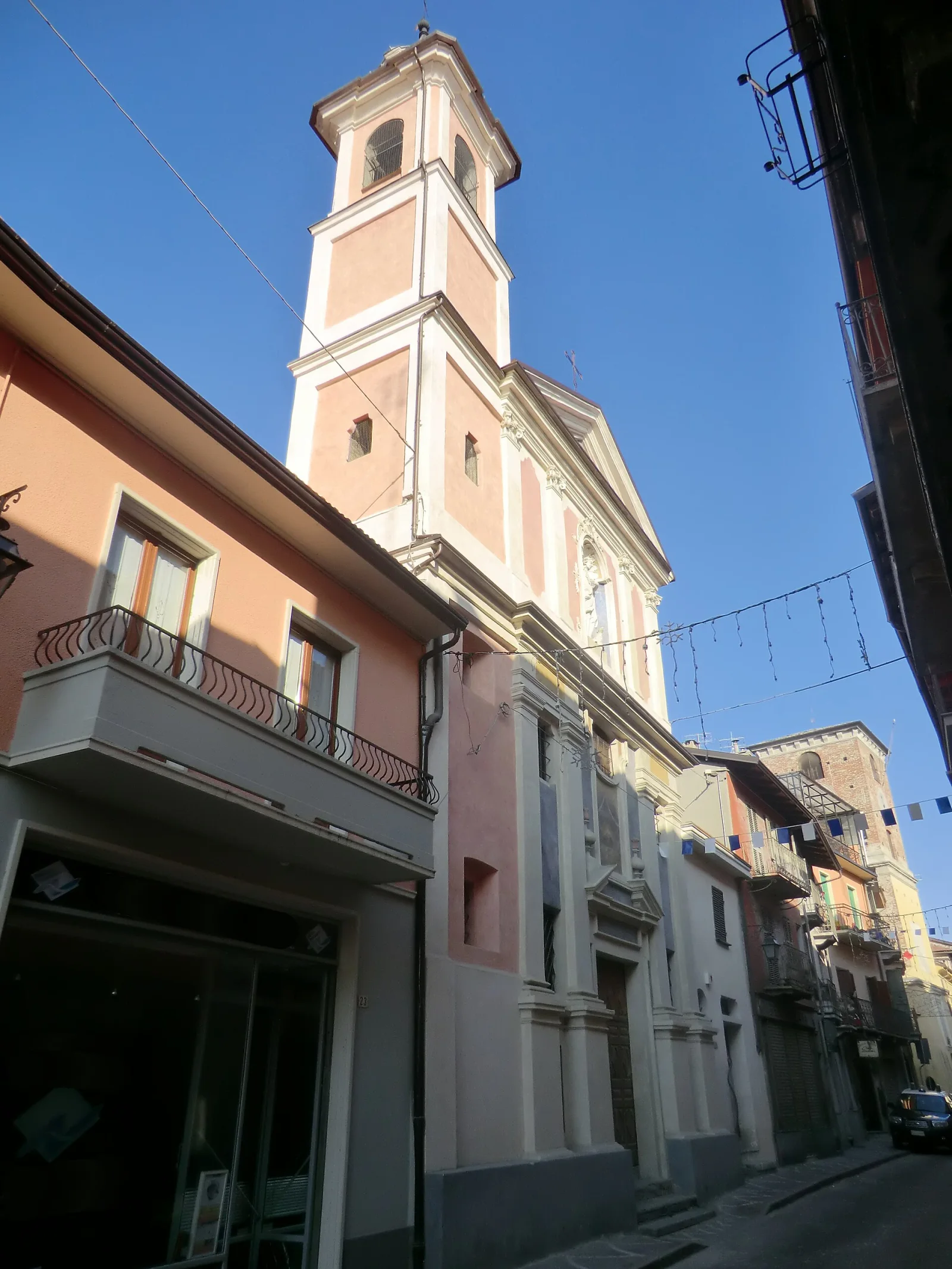
The church of the confraternity of Saint John the Baptist Beheaded stands on via Roma. The company was founded in Borgo San Dalmazzo at the end of the sixteenth century and approved by papal bull on 7 December 1604; at first it was based in the crypt of the church of San Dalmazzo. Its task was the one the title implies: to attend those condemned to death right up to the execution. In 1680 the rector announced the intention of building an oratory of their own, closer to the place of punishment, and the bishop of Mondovì granted the licence on 19 May of that same year.
What to see
The building was modest in size and soon proved too small: an enlargement became necessary around 1730, while the bell tower went up between 1750 and 1751. At the start of the eighteenth century the original altar was replaced by a new one, framed by a fine late baroque screen in polychrome Lombard marbles. The balustrades belong to the same season: each barrier has eight late baroque balusters and four pilasters, joined by a finely moulded and inlaid base and cornice, in compact Lombard limestone with inserts of Orobic marble. Above the altar hangs the most important piece, a painting of the beheading of Saint John the Baptist, dated 1580 and attributed to Giovanni Angelo Dolce of Savigliano.
Visiting
This is not a church for casual visits: it opens on 24 June for the saint's feast, and for the rest of the year only by appointment. Anyone passing through Borgo San Dalmazzo outside that date should still stop in front of the facade and then walk the few minutes to the abbey of San Dalmazzo: the crypt where the confraternity met before it had premises of its own is down there, and the two stories hold together.
Our editors' tip
It is worth remembering what this company existed for, because that is why the oratory stands where it does. The brothers accompanied those about to be executed, stayed beside them to the last and collected the body afterwards: they built their church near the place of execution so as not to have far to come. The painting over the altar, with the Baptist's severed head, was not chosen out of a taste for the macabre. It was their trade, set down in writing above the altar.