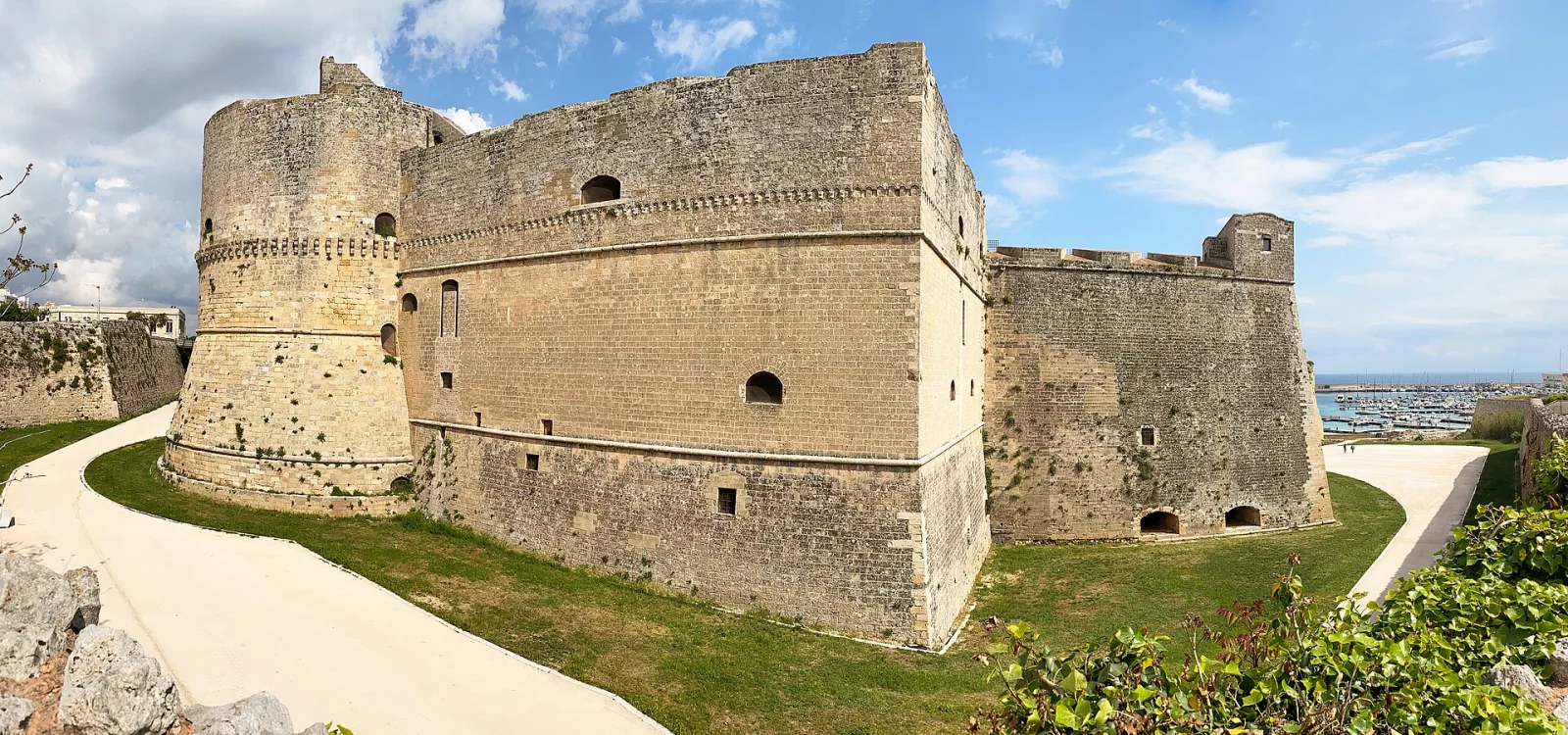
In 1764 an English writer, Horace Walpole, published a novel set in an Apulian castle full of secret passages, ghosts and giant helmets falling from the sky: it was called The Castle of Otranto and it started the whole of Gothic literature, that is a couple of centuries of ghost stories. Walpole had never been to Apulia: he picked the name off a map because it sounded good. The real castle, however, exists, and it is far less romantic and far more serious.
What to see
It was built by the Aragonese at the end of the fifteenth century, after the Ottoman fleet took the city in 1480: it is an artillery fortress, polygonal in plan, with three cylindrical towers, a moat and sloping walls to make cannonballs bounce off. You can walk the ramparts, the inner halls and the underground rooms, and the structure reads perfectly clearly because it was never turned into a residence.
Today it houses exhibitions and events, and from the terraces you see the harbour and the sea that leads towards Albania, visible on clear days. Not far off, in the cathedral, are the great mosaic floor with the tree of life and the chapel where the bones are kept of the inhabitants killed during that taking of the city.
Visiting
The castle is in the old town of Otranto, behind the harbour; ticketed, open daily with seasonal hours, longer in summer. Three quarters of an hour. The town around is small and can be walked in half an hour, cathedral included.
Our editors' tip
Go up onto the ramparts and look east: from here you understand why this city was taken, defended and retaken for centuries. It is the easternmost point of Italy, the sea is narrow and on some days the opposite coast can be seen with the naked eye. Then go into the cathedral: what happened here in the fifteenth century is the reason the castle you have just visited was built.


