In 1860, with Palermo taken, its citizens asked Giuseppe Garibaldi for permission to be rid of the castle that had held them under its guns for centuries: they stormed it and pulled much of it down. Picks and time did the rest. It served as a barracks until 1922, then demolition went on in the name of the Giarrusso master plan of 1886, and the air raids of the Second World War finished the job. An Arab fortification already stood here in the ninth century; the real fortress was built by the Normans of Robert Guiscard and Count Roger, and until the twentieth century it was the defensive bulwark of the port of Palermo.
What to see
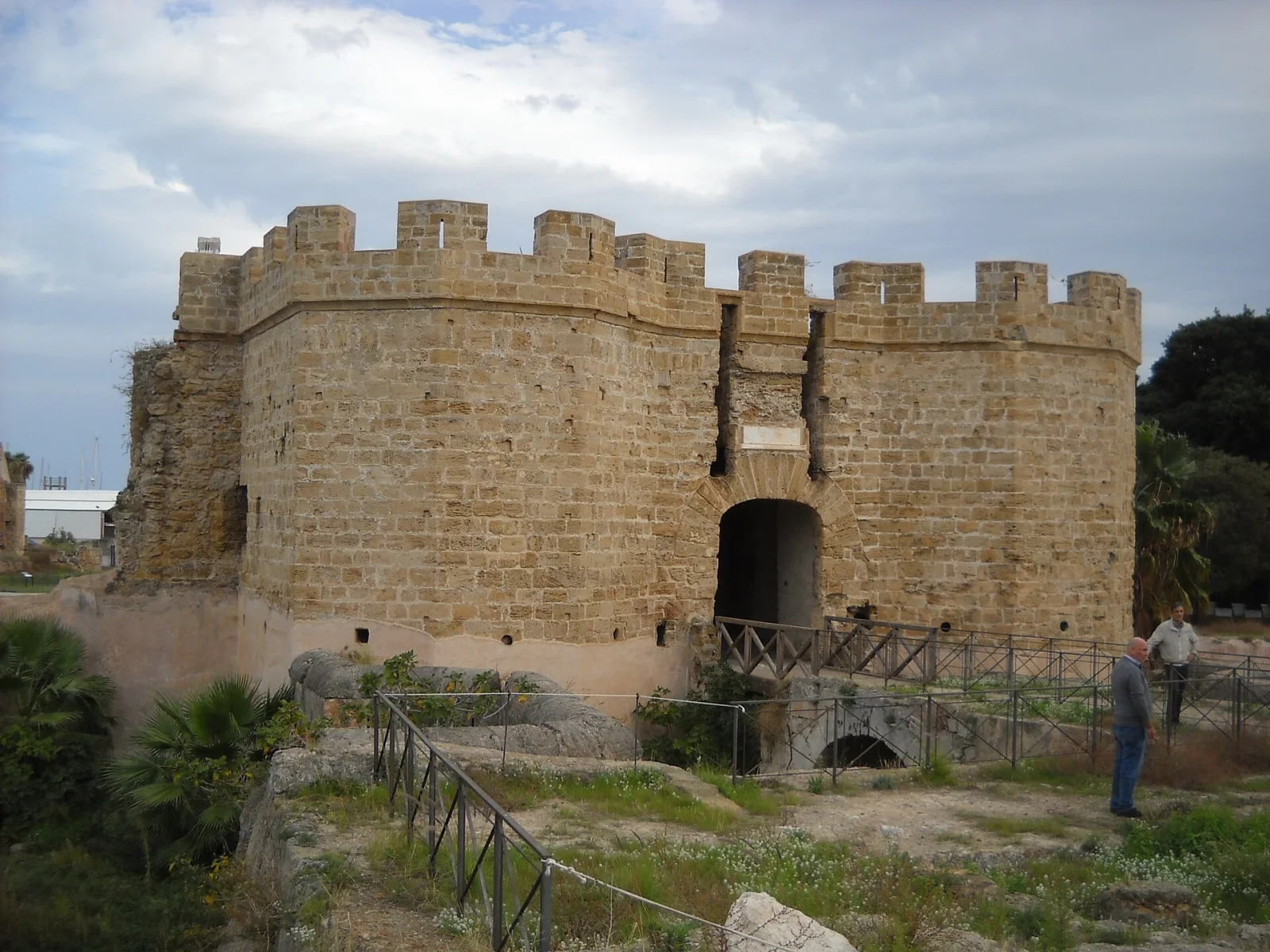
Of a complex that until 1922 had a square curtain wall washed by the sea on two sides, three pieces survive: part of the main keep, the cylindrical tower and the entrance block, the so-called Aragonese gate. Around them emerge the star-shaped Renaissance bastions, the landward defence strengthened in the time of Charles V. Gone instead are the Renaissance palazzetto, the sixteenth-century church of the Madonna di Piedigrotta built over a mosque, the Norman chapel of the Bagnara and the loggia that faced Santa Maria della Catena.
The stones record a succession of masters. In 1333 the fleet of Robert of Anjou tried to take it; until 1337 it was the favourite residence of Frederick III of Sicily, who rewrote in his own hand the rules of the prisons kept inside the walls. In 1417 Blanche of Navarre had a moat dug and bars fitted to the windows. An inventory of 1478, drawn up on the death of the castellan Giovanni Antonio Fuxa, lists weapons and stores. Between 1553 and 1601 the castle housed the tribunal of the Inquisition, later moved to the Steri. On 29 August 1593 two powder magazines blew up: among the dead was the poet Antonio Veneziano, held here on a sentence for defamation.
Visiting
The remains are the core of the Castellammare archaeological park, opened in 2009 after excavations begun in 2006 cleared away the shacks that had grown up after the war. You are on the trapezoidal pier, two minutes from the Cala and the hydrofoil quay: walk in from piazza Marina or along the seafront, with no climb. The site is fenced and seen at ground level, among stumps of towers and wall lines marked out on the paving; half an hour is enough, and full light helps, since there is no shade. Opening times change often, so check before crossing the city.
Our editors' tip
Look for the marble plaque at the entrance: it records the enlargement ordered in 1496 by Ferdinand II of Aragon, when corsair raids were routine. Then walk back towards the Cala to the church of San Giovanni dei Napoletani, finished in 1617: it exists because in 1526 Charles V had the Neapolitan community's first church demolished, judged too close to the castle's bastions. It is the quickest way to grasp how much room this fortress took up.