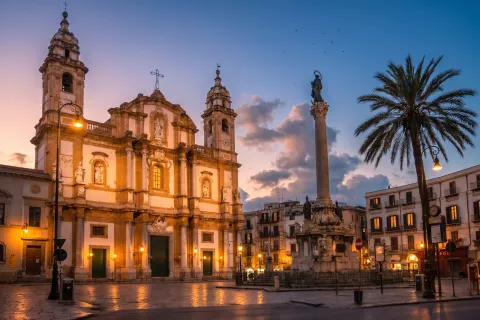
The columns dividing the nave were cut, almost all of them, from a single block of grey marble at Monte Billiemi behind Palermo. One shattered on the way into town, and the street where it happened is still called via Colonna Rotta. The church is the outcome of a long chain of handovers: from 1398 the site held the church of Sant'Elia at Porta Giudaica, which the carpenters' guild obtained in the sixteenth century, on condition that they kept its dedication, after being evicted from their own. The Theatine fathers, who had come from Naples at the invitation of the Palermo Senate, took it over in 1602 and in 1612 began the present building, designed by Pietro Caracciolo and supervised to the end by the Theatine lay brother Giacomo Besio, a stonecutter from Savona. The church opened in 1632 and was consecrated in 1677.
What to see
The barrel vault over the nave carries gilded stuccowork by Paolo Corso to designs by Giacomo Amato and the frescoes Filippo Tancredi painted in 1693, showing the apotheosis of Saint Cajetan of Thiene and of the Theatine order. What you see is not the original: bombs went through the roof in 1943, and the vault, its plasterwork and the floor were remade between 1950 and 1954 from photographs taken before the war. In the pendentives of the twelve arches stand the twelve apostles by Antonio Manno, dated 1799. The thirty-four columns have Corinthian capitals and white marble bases.
The dome is by Giuseppe Mariani: majolica-clad outside, frescoed inside by Guglielmo Borremans in 1724 with the fall of the rebel angels. The side chapels hold the Madonna di Trapani by Antonello Gagini and the wooden crucifix by Fra Umile da Petralia; on the inner façade are two holy water stoups borne by angels, by Ignazio Marabitti and his pupil Federico Siracusa, and the Madonna dell'Oreto by Domenico Gagini. The statue of Saint Joseph over the main door is by Baldassarre Pampillonia, 1738, with the carpenters' coat of arms, a crowned axe, below the niche. The flank on via Maqueda ends in an octagonal bell tower that was never finished.
Visiting
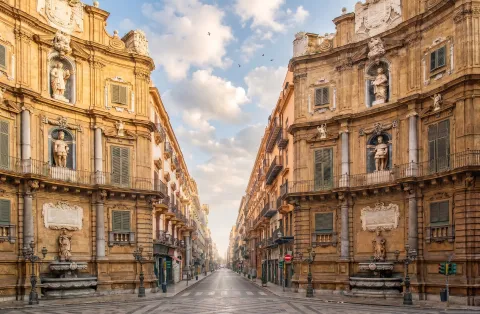
The church stands at the south-west corner of the Quattro Canti and forms one of its fronts: the main entrance, classical in style, is on via Vittorio Emanuele, while the east flank runs along via Maqueda facing the Fontana Pretoria. Entry is normally free and the hours follow the services, so mornings are the safest bet. Below the floor lies the crypt church, lit by the grated windows you can see from the street: it preserves remains of the older building dedicated to the Madonna of Providence and is visited separately. Twenty minutes for the church, twice that if you go down.
Our editors' tip
Our advice is to walk round the block before going in: from Piazza Pretoria you get the east flank, with its flying buttresses and a small dome over each bay, a side almost nobody looks at because everyone is photographing the fountain. Then stop in front of the Baroque doorway on via Maqueda and look for the year the church opened for worship, cut into one of the capitals: the masons left it there like a signature.