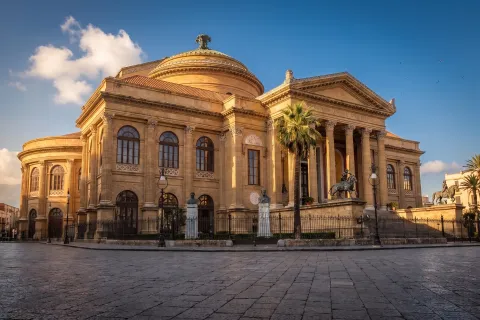
A bronze quadriga runs above the triumphal arch that serves as the entrance: it is the Triumph of Apollo and Euterpe, modelled by Mario Rutelli, flanked by two horsemen by Benedetto Civiletti. The Politeama was born as an open-air daytime theatre, popular and cheap, the exact opposite of the Teatro Massimo the city was planning in the same years: operetta, equestrian shows, festivals. The design is by Giuseppe Damiani Almeyda, who won the municipal competition and delivered his first drawings in 1866. It opened on 7 June 1874, still unfinished and still without a roof, with Bellini's I Capuleti e i Montecchi; the metal covering came out of the Fonderia Oretea in 1877 and was, for its day, a serious piece of engineering. It took Garibaldi's name in 1882, and the official opening waited until 1891 and the National Exhibition, with Verdi's Otello sung by Francesco Tamagno in front of King Umberto I.
What to see
From outside the theatre is a half-cylinder: two orders of columns curving round like a Roman amphitheatre reread through Pompeian architecture, with the triumphal arch in the middle. On either side of the entrance are the plaques with epigraphs dictated by the historian Isidoro La Lumia; in the side gardens stand a Bacchante by Valerio Villareale, a Sylph by Benedetto De Lisi and a David by Antonio Ugo. The cylindrical body suggests the Pantheon, while the semicircular front hiding a conventional hall recalls Semper's first Hoftheater in Dresden.
Inside, the hall is a horseshoe with two tiers of boxes and a deep gallery: at the opening it held five thousand people, a figure that says everything about the theatre for the people Damiani Almeyda had in mind. The polychrome Pompeian-style decoration of the loggias was painted by a team of Palermo artists, among them Nicolò Giannone, Luigi Di Giovanni, Rocco Lentini and Michele Cortegiani, and was restored in 2000, when the city hosted the G8. The foyer housed the municipal gallery of modern art from 1910 to 2006.
Visiting
The theatre stands in Piazza Ruggero Settimo, where the street of the same name ends and Viale della Libertà begins: ten minutes on foot from the Teatro Massimo in a straight line. The square is the meeting point of the whole city, and the arch with its quadriga costs nothing to look at, best from the opposite pavement, the only one from which the whole thing fits in the frame. The simplest way in is a concert: since 2001 the Politeama has been home to the Orchestra Sinfonica Siciliana, which plays its season here. Outside concert nights, access to the hall depends on the guided tours on the calendar, so check first. An evening of music takes the whole evening; twenty minutes are enough for the outside.
Our editors' tip
If you come for a concert, take a seat up in the gallery rather than in the stalls: it costs less, the sound arrives full, and above all it is the point from which this hall should be seen, because that is where the audience it was built for used to sit. We would also walk round the block: the rear façade shows the full curve of the half-cylinder, and almost nobody goes that way.