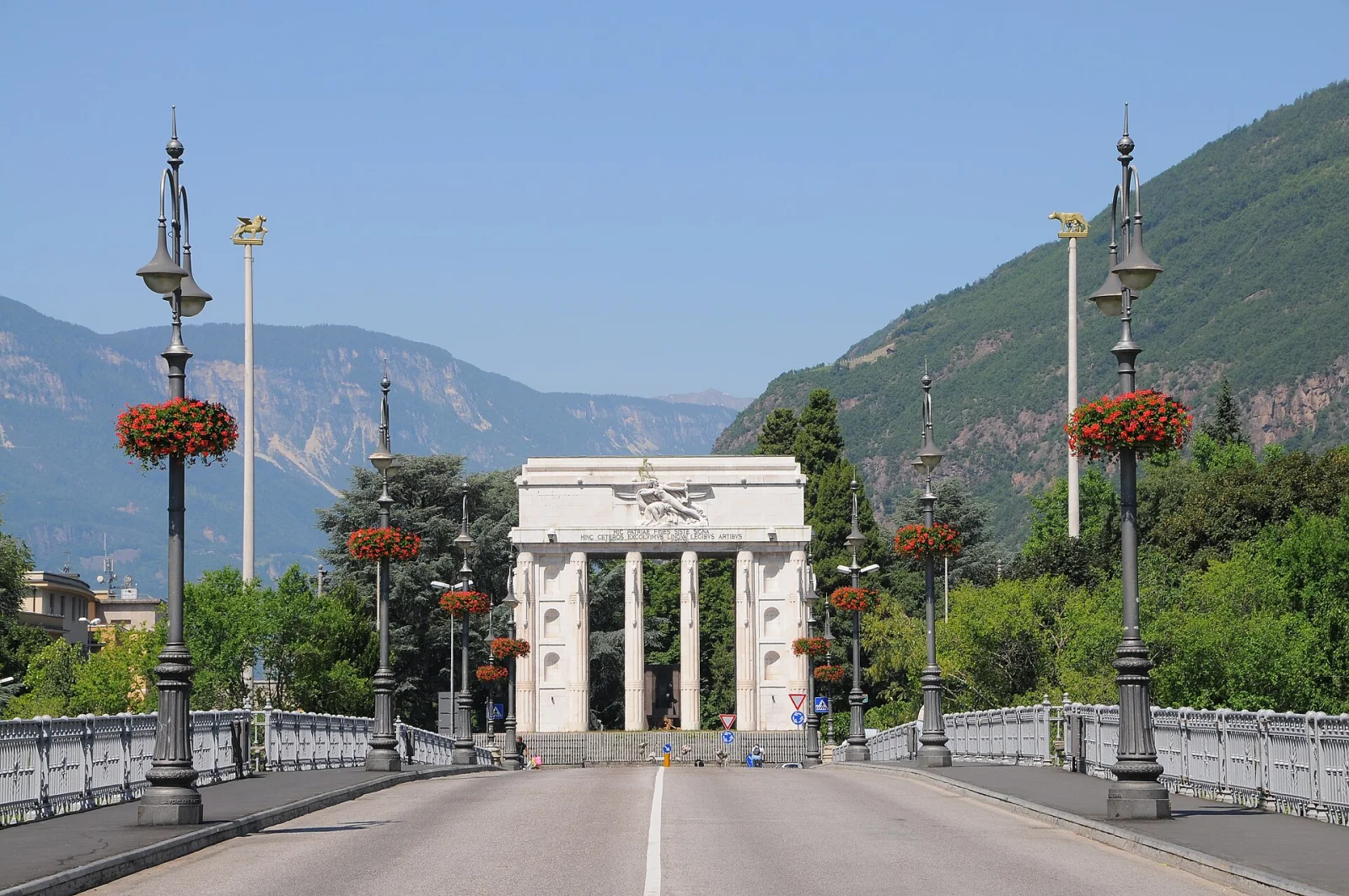
At the head of the bridge over the Talvera, between the old Bolzano and the one built by fascism, stands an arch of white marble with fourteen columns shaped as lictors' fasces. The Victory Monument was designed by Marcello Piacentini and inaugurated in 1928, on the exact spot where the Austrians had begun to raise a monument to their own dead, demolished to make room for this one. Along the architrave runs a Latin inscription saying, in substance, that here the fatherland ends and that from here the others were educated with language, laws and arts.
What to see
The monument is Piacentini's marble at its coldest: fasces-columns with axes instead of capitals, reliefs, and at the centre a risen Christ carved by Adolfo Wildt, with other sculptures by Arturo Dazzi and Libero Andreotti. It is worth looking at the way you look at a document: every element says something precise about who ordered it and what he wanted those crossing the bridge to understand.
In the crypt, under the columns, since 2014 there has been a permanent exhibition telling the story of Bolzano between the two dictatorships: the annexation, the italianisation, the options of 1939, the war, the transit camp. It was made by historians and it did what decades of controversy had not, that is, turn a symbol into an object that can be explained. Around one column, a ring of light carries the project's name in the three languages of the province.
Visiting
The monument is in piazza della Vittoria, ten minutes on foot from piazza Walther across the Talvera bridge; it can always be seen and from outside it is free. The documentation centre in the crypt has free entry with limited hours and a weekly closing day, to be checked. Three quarters of an hour in all.
Our editors' tip
Do not stop in front of it: go down into the crypt, because that is where the monument becomes comprehensible. Then come back up and cross the bridge on foot towards the old town: in three hundred metres you pass from medieval German-speaking arcades to rationalist Italian-speaking avenues, and you understand that this marble was never a piece of street furniture but a border drawn inside a city.


