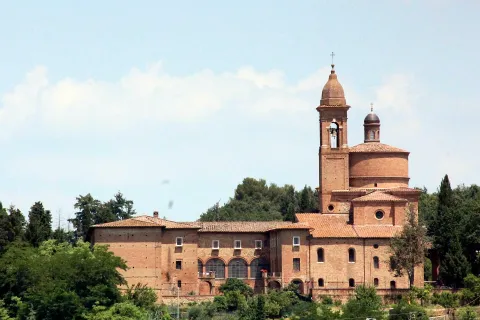
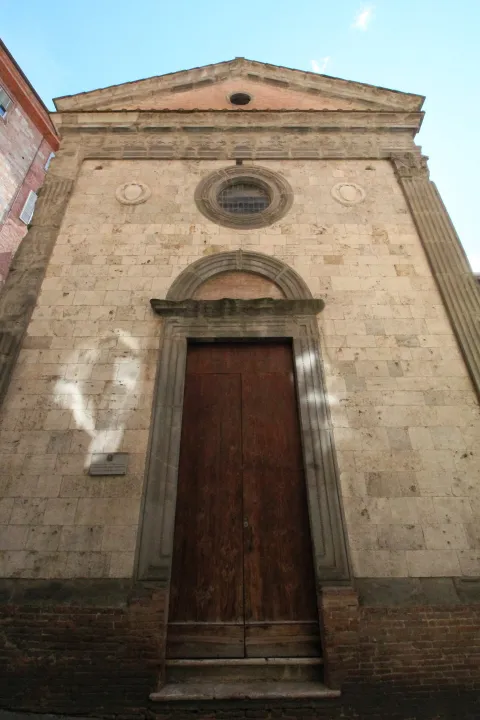
From outside it is a Gothic church like the others in Siena, brick and plain lines, at the end of a tree-lined green on the edge of the centre. Inside it is white: in 1755, after a fire, the friars called in Luigi Vanvitelli — the architect then building the palace of Caserta — and had him redo the interior. Out of it came a neoclassical nave, light and orderly, inside a medieval shell: one of the sharpest contrasts to be seen in Tuscany.
What to see
Despite the rebuilding, the works remained. There is Perugino's Crucifixion, painted for this church and still in its place, with the Umbrian landscape behind the figures; there is Sodoma's Adoration of the Magi, crowded and theatrical; and there are panels by the Sienese painters of the fourteenth and fifteenth centuries.
In the Piccolomini chapel are fragments of frescoes by Ambrogio Lorenzetti, brought back to light from under the whitewash during restoration: they are the remains of what was there before Vanvitelli's white, and seeing them next to the neoclassical work explains at a stroke what happened to this church.
Visiting
The church is in Prato Sant'Agostino, ten minutes on foot from piazza del Campo going up towards the botanical garden; it belongs to the city museum circuit, with seasonal opening and a ticket: out of season it may be closed, and it is worth checking. Half an hour.
Our editors' tip
Look at the Perugino close up and then walk back to the end of the nave: it was painted to be seen in a dark Gothic church, and it now hangs in a white, bright room. The picture still works, but differently, and that is perhaps the simplest way to understand what changes when a church interior is remade two centuries later.