Villa Almerico Capra (La Rotonda) ★
Calling it the Rotonda is inexact, and Palladio listed it among palaces, not villas.

 Museums Teatro Olimpico Palladio's final masterpiece is the oldest modern indoor theatre, retaining its original perspective sets from 1585.
 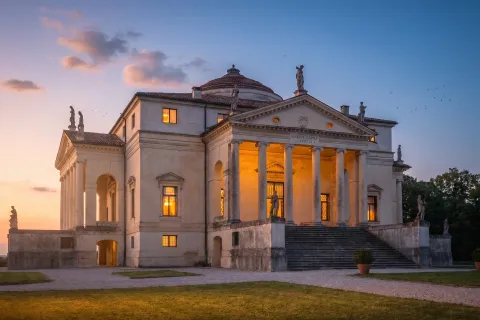 Castles Villa Almerico Capra (La Rotonda) Calling it the Rotonda is inexact, and Palladio listed it among palaces, not villas.
  Castles Basilica Palladiana Palladio's loggias around Vicenza's Gothic town hall: the serliana, the keel-roofed hall and the terrace.
  Castles Palazzo Chiericati Palladio's palace-villa on the piazza dell'Isola, now the civic museum: the stacked loggias and Van Dyck.
 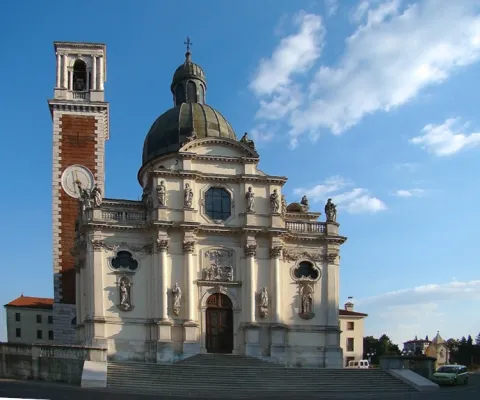 Churches Santuario della Madonna di Monte Berico The sanctuary above Vicenza, with its portico of a hundred and fifty arches and a slashed Veronese.
 37 places covered in Vicenza Grouped by type, most important first.
No place with that name: try fewer letters.
Calling it the Rotonda is inexact, and Palladio listed it among palaces, not villas.
Palladio's loggias around Vicenza's Gothic town hall: the serliana, the keel-roofed hall and the terrace.
Palladio's palace-villa on the piazza dell'Isola, now the civic museum: the stacked loggias and Van Dyck.
One of Palladio's earliest villas, shut and peeling behind the church of Bertesina.
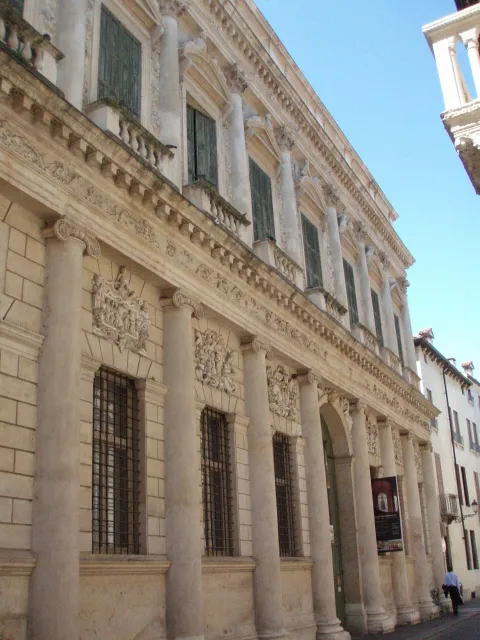
The only large palace Palladio managed to finish, now the museum devoted to Palladio.
The villa where a stonecutter met a humanist and came out with the name Palladio.
The Palladian palace willed by Isabella Valmarana, with its giant order.
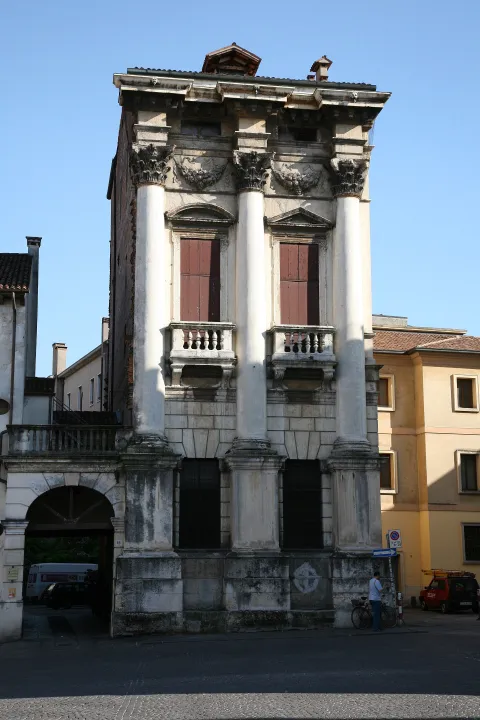
The fragment of a Palladian palace left unfinished on piazza Castello.
Palladian façade with three arches and four Corinthian half-columns, designed in the 1560s.
Palladio's first town palace (1540-1542), enlarged in 1750 and rebuilt after the bombing of 1944.
Villa with frescoes by Giambattista and Giandomenico Tiepolo (1757) and stone dwarfs along the boundary wall.
Gothic palace in contrà Piancoli (about 1460), where an intervention by Palladio has been suggested.
Scaliger 14th-century walls of Vicenza: the Rocchetta, Porta Santa Croce and pentagonal towers along viale Mazzini.
Scaliger gate of 1370, one of the three surviving medieval ones, with the lion of Saint Mark partly chiselled away.
The sanctuary above Vicenza, with its portico of a hundred and fifty arches and a slashed Veronese.
Bellini's Baptism, a Veronese, and Palladio's crypt, where Palladio himself was buried.
The Gothic cathedral with Palladio's dome, rebuilt after the bombs of 1945.
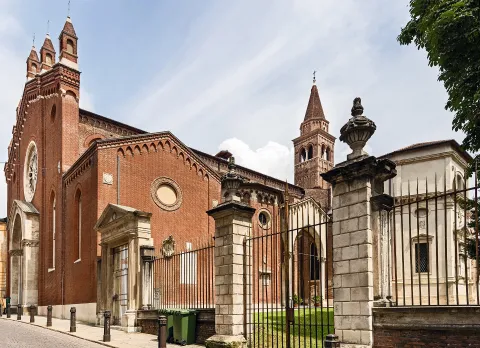
Gothic Franciscan church of the late 1200s, with a 14th-century portal funded by the bequest of a moneylender.
Church attributed to Palladio (1578), single hall with Corinthian half-columns; reopened to the public in 2024.
Oratory begun in 1505 with a 17th-century façade and a cycle of canvases by Maffei and Carpioni on Saint Nicholas.
Early Christian basilica (4th-5th century) with a sacellum, ancient mosaics and a Benedictine abbey.
Baroque church of the Discalced Carmelites (1720-1727), with eleven façade statues and Ricci's Ecstasy of Saint Teresa.
Baroque church attributed to Guarino Guarini (1675-1680), with an elliptical plan and a theatrical façade.
Early medieval church at Polegge with 15th-century frescoes, the peacock pluteus and a name still debated.
Church of the borgo of San Pietro, once centre of the most powerful Benedictine nunnery in the Vicenza area.
15th-century church in piazza Biade with a portal of 1531 that may be one of Palladio's first works.
Palladio's final masterpiece is the oldest modern indoor theatre, retaining its original perspective sets from 1585.
The wool merchants' baroque, with Russian icons and Pietro Longhi's scenes.
In the villa on the Monte Berico hill, the papers of Vicenza's wars.
Gino Valle's theatre opened in 2007 on viale Mazzini: a 910-seat hall, a 380-seat ridotto, suspended acoustic panels.
Roman theatre of Vicetia (late 1st century BC): its shape survives in the streets and in the walls of houses.
Large park of Vicenza at the foot of Monte Berico, municipal for centuries, its name still disputed: Marzo or Marzio.
Historic garden of 1592 with the Palladio-inspired Valmarana loggia, open to the public since 1909.
Twelve-hectare park between the Bacchiglione and Astichello, with an Ionic temple of 1820 and a pond.
Old forum and heart of Vicenza: Basilica Palladiana, Bissara tower, Loggia del Capitaniato and the two columns.
Bridge of Roman origin on the Bacchiglione (1st-2nd century AD), rebuilt several times; the present one is of 1950.
The underground corridor of a Roman house beneath Vicenza's cathedral square.
The closest destinations covered by our editors, with straight-line distance.