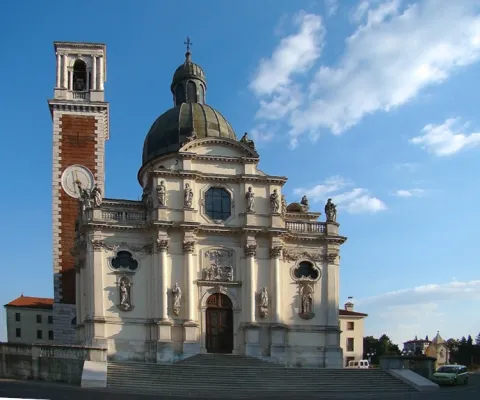
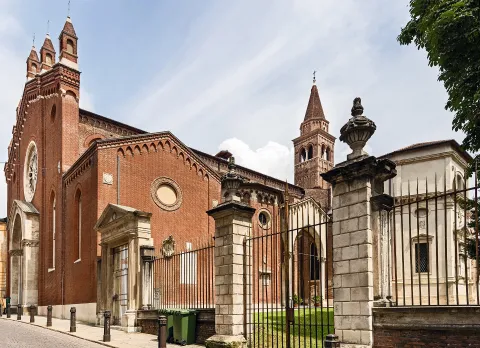
The basilica of Saints Felix and Fortunatus is a church in Vicenza, now a parish seat, whose origin dates to the 4th-5th century; its present Romanesque appearance is due to the rebuilding of the 12th century and the restorations of the 20th, and for over a millennium it was attached to the most important Benedictine abbey in the Vicenza area.
What to see
Where the basilica stands today there was in Roman times a pagan necropolis, just outside the walls, along the Via Postumia, with cappuccina tombs, aedicule tombs, sarcophagi, stelae and inscriptions. After the Edict of Milan the Christians of Vicenza reserved an area there to bury their dead and built a place of worship, the first evidence of the Christian faith in the city; from the end of the 4th century dates the stele of the Adoration of the Magi, the most important document of the Christian cemetery. The early church, built between the mid and late 4th century, was a single hall of about twenty-four metres by sixteen and a half, recognisable by a band of red marble in the floor of the present church, and had a rich mosaic pavement with decorative crosses in the Solomon's-knot form and panels with the names of the donors; a senatorial family contributed to the work, a sign of the importance the Christian community had already reached. After the translation of the relics of the martyr Felix from Aquileia, perhaps around 380, the church proved insufficient and between the end of the 4th and the middle of the 5th century a true three-aisled basilica was built, almost eighty-seven metres long with its atrium, with a plan close to that of Sant'Ambrogio in Milan. Shortly after the middle of the 5th century the sacellum, or Martyrion, was built, meant to hold the relics and considered one of the most interesting and best-preserved early Christian buildings in Italy: dedicated later to the Madonna, it served the cult of the martyrs until 1674, when it was turned into a service room of the monastery and the relics were moved to the basilica's crypt.
The excavations of 1943 brought to light the foundations of an octagonal building, identified as the ancient baptistery, and it is this that led some historians to think San Felice was the first cathedral of Vicenza, a hypothesis without confirmation in the documents. In the 8th century Benedictine monks settled here, building an abbey dedicated to Saints Vitus and Modestus that became the heart of their activity in Vicenza; according to tradition, Charlemagne stopped at the monastery and favoured it with a generous donation. In 899 the Hungarians set fire to the abbey and the monks scattered; in the privilegium of 983 Bishop Rudolf, a supporter of the Cluniac reform, gave the Benedictines a considerable amount of land, entrusting them also with the government of the territory, pastoral functions and the reclamation of extensive marshy areas, and the monastery provided itself with a defensive tower. The Benedictines of San Felice then founded countless churches and small monasteries along the ancient Roman roads leading out of the city.
Visiting
The basilica is a working parish church; opening hours, Mass times and the possibility of seeing the early Christian remains, the sacellum and the crypt should be checked with the parish, because the sources consulted do not give them.
Our editors' tip
Look in the floor for the band of red marble that marks the outline of the first church of the 4th century: it is the simplest way to grasp how old the history under your feet is.