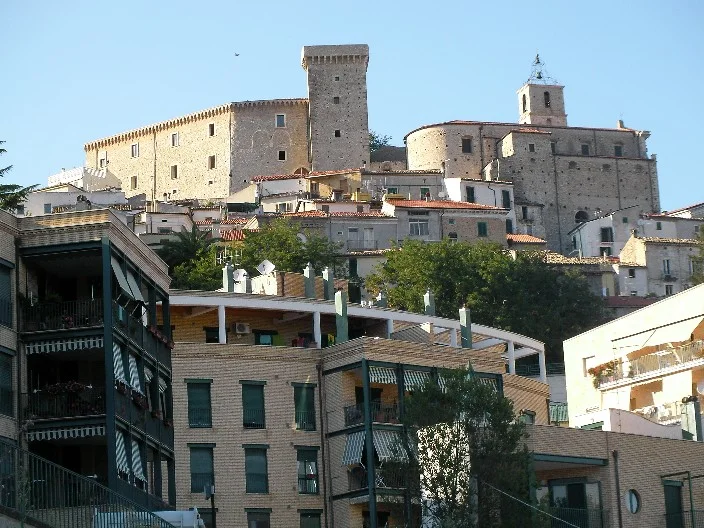
Casoli has 5,847 inhabitants on a hill to the right of the Aventino, at the foot of the Maiella. Down in the plain, at Laroma, lie the remains of a Roman town with palaces, baths and a theatre, which some archaeologists identify with Cluviae; when the Saracens came in the ninth century its people moved up onto a sharp hill and fortified themselves around a Lombard watchtower, which would later become the Norman keep of the castle. Their village was called Casulae, a huddle of small houses, and the name appears for the first time in 878, in a manuscript listing what the abbey of Montecassino owned in the Chieti country.
The hardest chapter is the war. From July 1940 to September 1943 the Fascist regime kept an internment camp at Casoli, in a building in via Roma with room for eighty or ninety people, for foreigners and antifascists. Then the front arrived: in November 1943 a German soldier threw a still-lit cigarette on the ground in front of Palazzo Di Florio, whose ground floor was full of munitions; the building blew up, killing German soldiers and civilians, and while it was still burning some of the townspeople went in to pull out those trapped, one of whom, Angelo Belfatto, was later given the silver medal for civil valour. And it was here, in those months, that the Brigata Maiella was founded, the partisan formation that would follow the front northwards.