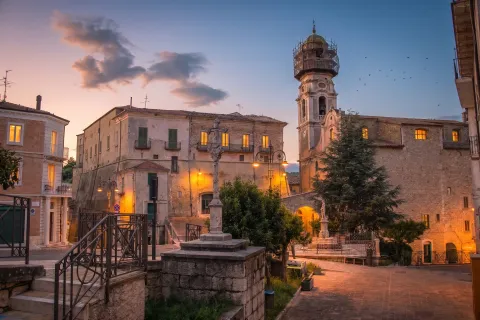
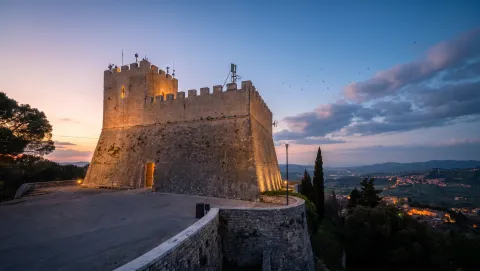
Local lore credits the castle at Castropignano with 365 rooms, one for every day of the year. The arithmetic is generous, but it captures how the d'Evoli residence looked from below: two main blocks on a terrace that drops straight into the Biferno valley, at the northern edge of the village.
What to see
Giovanni d'Evoli, a Norman baron of Frosolone, had the castle built in 1362 under Angevin rule, on the remains of a Samnite stronghold that had itself grown over older fortifications. The job was military: watching the Lucera-Castel di Sangro drove road, the track flocks followed down into Puglia. The family added the south turret, modernised the state rooms and dug out a basement floor for the servants. A moat, later filled in, faced the village, and two heavy towers tied the castle to the houses below.
Across the fifteenth and sixteenth centuries the fortress turned into a lordly home hung with tapestries and canvases; the last enlargement dates from 1683. Its owners counted for something in the Kingdom of Naples: Andrea d'Evoli, counsellor to Alfonso I of Aragon, wrote the De mena pecundum in 1447, a set of rules for moving flocks along the drove roads. Then came the nineteenth-century sale after feudalism was abolished, furnishings stripped to settle debts with the State, abandonment, and the wartime bombing that sent part of the building sliding down the slope.
Visiting
The approach is on foot along via Salita San Marco, then via Marconi and via Castello: short, and uphill the whole way. The site belongs to the Molise heritage authority and was reopened thanks to restoration work carried out in the closing years of the twentieth century. Some losses are permanent: the eighteenth-century monumental staircase by Silvestri da Sepino and the arcades of the inner loggia are gone.
Our editors' tip
Before or after the castle, walk out to the Cantone della Fata, the rocky ravine attached to the legend of the jus primae noctis: a young village bride known as Fata is said to have thrown herself off rather than spend her wedding night with the duke. Cyclopean walls dated between the fifth and third centuries BC surface nearby, and close to the castle too: this hill was garrisoned long before the Normans.