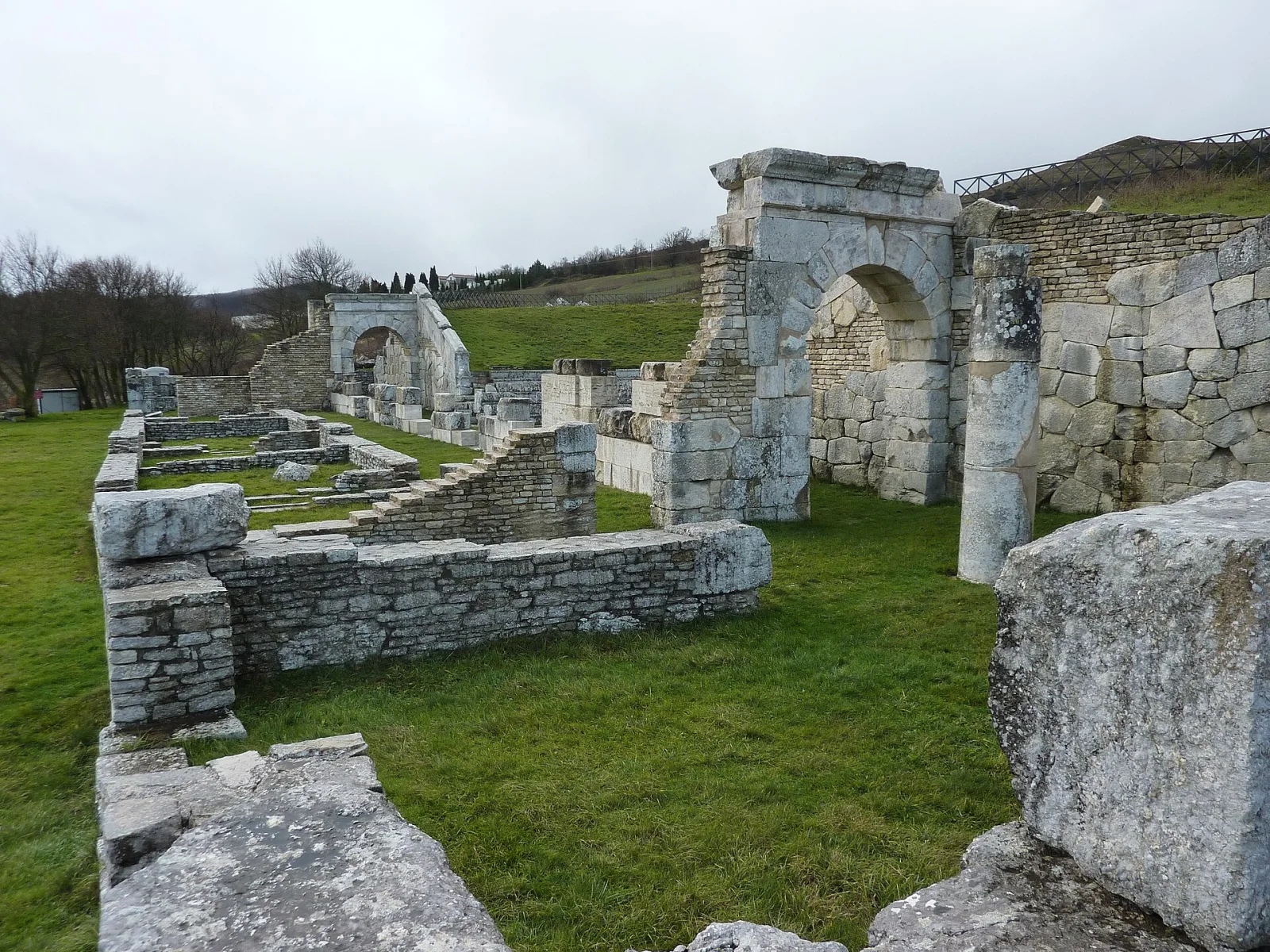
Digging the oldest levels, archaeologists mostly found weapons. They did not belong to defenders: they were spoils, taken from beaten enemies and consecrated here to the goddess Victory, the only deity whose name a bronze plaque found near the larger temple hands down with certainty. That also explains an absence: ancient weapons turn up very rarely elsewhere in Samnium, because they all ended up here.
The sanctuary, at 966 metres on the slope facing the Trigno valley, was not a place of worship like the others. At the other Samnite sanctuaries — San Giovanni in Galdo, Vastogirardi, Campochiaro, Schiavi d'Abruzzo — theatrical games were held; here the concilium met as well, the assembly of the senate. The inscriptions name the supreme magistrates of the state: the meddix tuticus, the censor, the quaestor. This is the closest thing to a capital the Pentri Samnites ever had.
What to see
Theatre and temples came out of a single design by an architect whose name is lost, and building began around 120 BC, continuing until the Social War dried up every source of public and private money. The theatre follows Campanian models: its layout recalls Sarno and the small theatre at Pompeii, while the podium of the larger temple copies the temple at Capua. The smaller and older temple stands to the north-east, linked to the theatre by a portico lined with shops.
The surprise is in the plan of the larger temple. On the podium, beyond the central steps, there is not one cella but three, in the Etruscan and Latin manner: it must therefore have been dedicated to a triad, and it remains the only known case in Italic architecture. The buildings line up on parallel longitudinal axes facing east-south-east, and the eight-metre drop between the two ends of the terrace was absorbed by the design. Nothing here is accidental.
Our editors' tip
Look up at Monte Saraceno, which closes the horizon behind you. On the summit, at 1212 metres, the polygonal walls of a fortified stronghold survive, part of the defensive system the Samnites built in the fourth century BC after their first clash with Rome: those forts were within sight of one another and formed a network of control over the land. The path climbing along the eastern slope follows a route already used in antiquity. No major road has ever come this way, and perhaps that is exactly why the sanctuary reached us at all.


