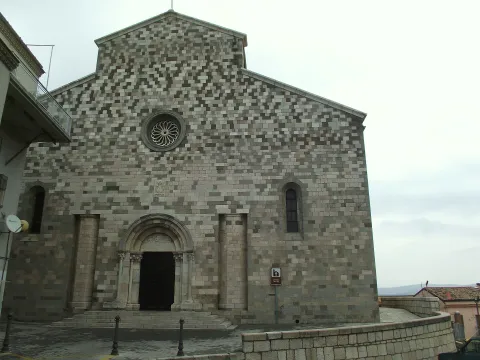
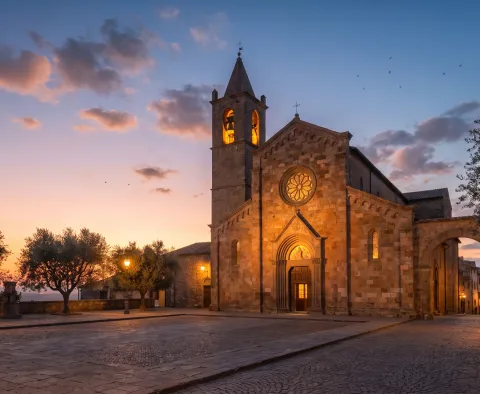
On the main vault hangs a painting that records who built the church and when: the confraternity of the dead, around 1640, under the supervision of Raffaele Daniele. It is an unusual signature, and a useful one, because from outside the building looks nothing like a seventeenth-century church. Centuries of accumulated restoration gave it an eighteenth-century façade already leaning towards neoclassicism, and most of the altars inside date from the nineteenth century.
What to see
The façade is gabled and split in two by a cornice: below, the local-stone portal under a segmental pediment; above, a narrower band with a half-moon window; rusticated pilaster strips at the sides and a pediment on top. Inside, a single nave with three chapels along each side and a semicircular apse. The high altar, between presbytery and apse, was made in the second half of the eighteenth century and is Neapolitan Baroque down to the details: an altar frontal with scrolls and marble inlay, a table on scrolled corner supports, a tabernacle with a dove with open wings, winged putti on the crest. Three canvases from the first half of the seventeenth century are set into the coffered barrel vault: the Coronation of the Virgin, a Madonna and Child among saints and souls in Purgatory, and a Madonna and Child with Saints Anne and Joachim. On the inner façade, the choir loft with its nineteenth-century organ.
On the way out, immediately to the left, a small square holds a wayside cross bearing the same year as the nearby Fontana dello Steccato, 1713: both belonged to the same scheme of embellishment ordered by the town's administrators. The base is a rectangular block on a stepped platform, and its four faces show an hourglass with an inscription, a crowned skull, a skull in a bishop's headgear and a skull ringed with a wreath of leaves. Above it a column, gadrooned at the bottom and fluted higher up, carries a composite capital and the cross, with a Crucifix in the Byzantine iconography of the dead Christ, the head fallen onto the left shoulder and a skull at its foot; on the back, the Virgin veiled and crowned, at prayer.
Visiting
The church stands in the old town, a few steps from Piazza Garibaldi and the Fontana dello Steccato. Look up first, towards the vault: the three seventeenth-century canvases are the oldest thing on view, together with the four Neapolitan-school paintings of 1640 kept inside. On 15 June, in front of the church, bread and household animals are blessed, a custom Barile repeats every year.
Our editors' tip
Do not stop at the portal: walk right around the wayside cross on the square, face by face. The skulls are not the same one three times over — one wears a crown, one a bishop's headgear, one a wreath of leaves — and the fourth face replaces the skull with an hourglass and an inscription. Then go looking for the Madonna del Carmine painted at the end of the eighteenth century: it is not here, but in the church of the former Carmelite convent of Santa Maria del Carmine.