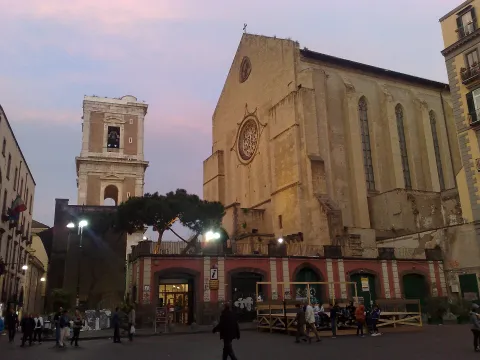
Under this church lies Greek and Roman Neapolis, and it is not a manner of speaking: you go down from the cloister and walk in the macellum, the covered market of the imperial age, with its shops, the bakery, the laundry and the public treasury, ten metres below Via dei Tribunali, at the exact spot where the agora stood. Above, the Franciscans who arrived in the time of Saint Francis and Charles I of Anjou, who from 1270 paid for the Gothic rebuilding: the apse with its ambulatory and radiating chapels is by French architects and is the only one of its kind in Italy. Here Boccaccio, in 1334, saw Fiammetta at Mass on Holy Saturday and fell in love with her; here Saint Louis of Toulouse was ordained a priest, the king's son who gave up the throne for the habit.
What to see
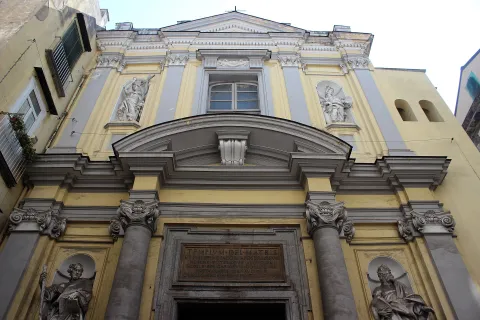
The single nave, eighty metres long, with a trussed roof, stripped in the twentieth century of the Baroque additions and Gothic again; at the end, the French apse with its nine radiating chapels, the finest thing. In the transept the Angevin tombs, Charles of Durazzo and Robert of Artois, and that of Catherine of Austria by Tino di Camaino, with the caryatids holding up the ark. Baroque on purpose remain the great chapel of Sant'Antonio and the Cacace chapel by Cosimo Fanzago, with inlaid marbles and the statues by Andrea Bolgi, a pupil of Bernini, and the façade of 1742 by Ferdinando Sanfelice, which however kept the fourteenth-century wooden doors. Simone Martini's Saint Louis and Colantonio's panels, painted for this church, are at Capodimonte.
Then the complex: the cloister, the chapter hall with the frescoes of the Virtues and the Sala Sisto V, where the parliament of the Kingdom met, with its painted ceiling; the museum of the Opera on three floors, with the finds from the excavations and the history of the quarter; and the excavations, open since 1992 after twenty-five years of work, the only large piece of ancient city visible in the historic centre, with the basalt-paved street and the intact shops, flooded now and then by groundwater.
Visiting
The basilica is on Piazza San Gaetano, on Via dei Tribunali, where San Gregorio Armeno begins; entrance to the church is free, with church hours, while excavations, cloister, halls and museum have a single ticket and their own hours, as a rule every day. An hour and a half for everything; the excavations alone half an hour. Underground it is cool even in August.
Our editors' tip
Do the excavations first and then the church: coming out of the macellum and climbing into the Gothic nave you understand that in Naples the cities lie one on top of the other, and that the centre has never moved a metre in twenty-five centuries. Then, in the church, look for the tomb of Catherine of Austria and look at the faces of the caryatids: they are the first portraits of Neapolitan Gothic, and they are alive.