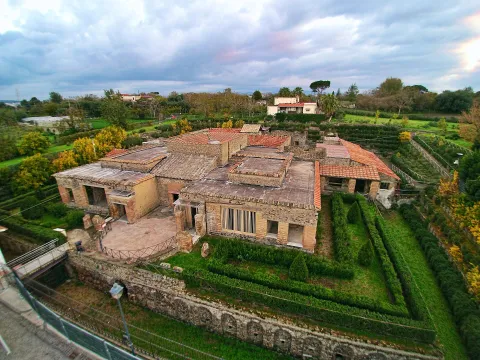
It is the largest house in Pompeii, an entire block on the Via di Nola, almost three thousand square metres with two atria and two peristyles: the town villa of a Samnite family, the Satrii perhaps, who around the second century BC wanted a residence fit for a Hellenistic king in a city where Oscan was still spoken. It owes its name to the small bronze of the satyr dancing on the impluvium, a satyr in fact and not a faun, and its fame to the mosaic that lay on the floor of the exedra, the battle between Alexander and Darius, the most famous piece of Pompeian archaeology. The bronze was found in 1830, at the start of the excavation of the house; both originals are in the Archaeological Museum of Naples and here there are the copies, but the house is all real.
What to see
On the threshold, written in coloured tesserae in the floor, the greeting HAVE, in Latin and not in Oscan: the owner wanted it known that he was cultured. Then the vestibule with its floor of marble triangles, the Tuscan atrium with the white stone impluvium and the dancing satyr in the centre, the walls in First Style imitating slabs of coloured marble, the largest surviving example of that fashion, and the mosaics of the rooms around: the tragic masks, the cat seizing a partridge, the doves stealing a necklace, the fish. In the tablinum was found the skeleton of a woman trying to save coins and jewels.
Behind, the first peristyle with Ionic columns, and in the exedra between the two gardens the place of the Alexander mosaic: the copy has been on the floor since 2005 and gives the idea, but the original in Naples, with about a million and a half tesserae, reproduced a lost Greek painting by Philoxenus, with the gaze of Darius turning on his chariot. On the threshold the Nile mosaic with hippopotamuses and crocodiles, a sign that the artists, or the fashions, came from Alexandria. Finally the second peristyle, immense, with forty-four Doric columns on two orders, where the owners gave performances, and the service wing with the first heated private bath in Pompeii.
Visiting
The house is in Regio VI, along the Via di Nola, ten minutes from the Porta Marina entrance passing through the forum; it is included in the ticket for the excavations, almost always open, with the hours of the archaeological park. Twenty minutes, but it is worth coming back in the late afternoon, when the light enters low into the atrium. For the originals, the satyr and the battle, the room in the Archaeological Museum of Naples.
Our editors' tip
Go in and stop on the threshold of the atrium without going further: from the entrance you see, on one axis, the impluvium with the satyr, the tablinum, the first peristyle and at the end the exedra with Alexander, a perspective of tens of metres built on purpose for whoever came in, so that he understood at once whom he was dealing with. It is the house as it was conceived: a stage set, with the master at the far end.