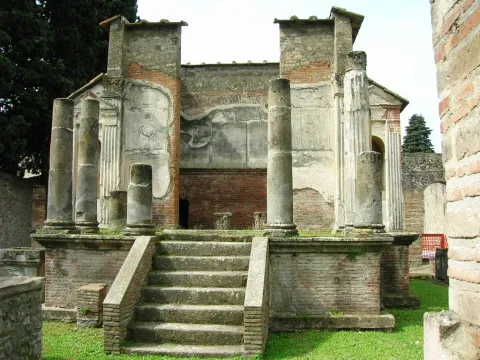
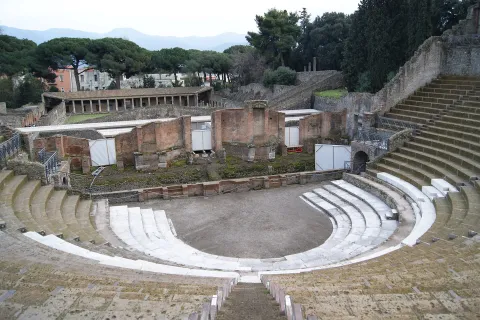
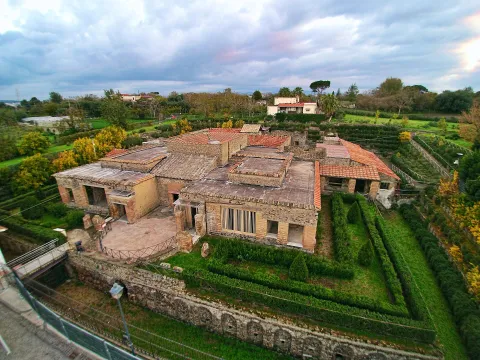
In 1930, digging the cellars of this house in Pompeii, archaeologists found a wooden chest holding 118 pieces of silver tableware, wrapped in cloth and carefully packed. Someone had put them safe at the deepest point of the house, perhaps during the building works, perhaps as Vesuvius began to rumble. The House of Menander is one of the largest houses in the city, almost 1800 square metres, and takes its name not from its owner but from the portrait of the Greek poet Menander painted in a niche at the far end of the garden.
What to see
The house reads like a stratigraphy: the atrium is the oldest part, of 250 before Christ, and modest compared with the rest; a century later came the tufa capitals of the entrance and the tablinum; in the Augustan age the owner bought and demolished his neighbours' houses to open the great colonnaded peristyle, and fitted out private baths on the west side, with their sequence of hot and cold rooms. To the east, on the other side, are the kitchens, the stables and the servants' quarters.
The paintings are of the fourth style, and the most striking room is the one with the scenes of the fall of Troy: the horse, Cassandra, the Greeks coming out of the wood. Along the back wall of the peristyle runs the row of niches, and in the central one Menander sits with a scroll in his hand. The owner of the final hour was called Quintus Poppaeus: the name turned up on a bronze seal found in the servants' rooms, the one document that says who lived here.
Visiting
The house is in Regio I, just inside the Porta Anfiteatro entrance and along via dell'Abbondanza; it is covered by the site ticket. Twenty minutes, half an hour if you look at the paintings unhurried. The opening of the Pompeian houses rotates with shifts and maintenance: check the updated map at the gate. The silver is not here: it is in the National Archaeological Museum in Naples.
Our editors' tip
Do not look only for the frescoes: look for the building site. When Vesuvius erupted the house was under renovation, and archaeologists found amphorae filled with ready stucco and a temporary kiln set up in a corner. Those are the builders who never came back to finish the job, and in all Pompeii nothing makes that August day more concrete than a bucket left standing.