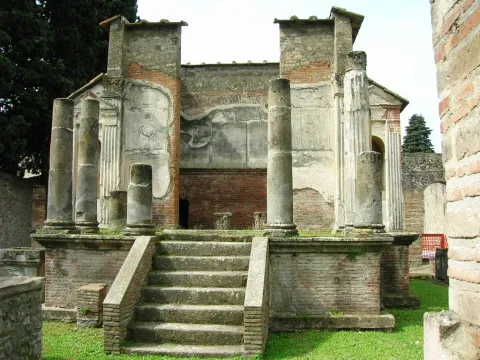
It is the oldest temple in Pompeii and for centuries the busiest: Apollo had come from Greece by way of Cumae, and as early as the sixth century BC there were altars here and a building with a roof of painted terracottas. The Samnites rebuilt it entirely, and in the floor of the cella there is still the Oscan inscription of the quaestor Oppius Campanus who paid for the works: it is one of the proofs that Pompeii, before Rome, spoke another language. Then the Romans came and Jupiter took the place of honour in the forum; the temple of Apollo was shut off by a wall so it could not be overlooked from the houses and narrowed to widen the square. The earthquake of 62 half destroyed it, and in 79 it was still a building site: the statue of the god was never found because it was with the restorer.
What to see
The sacred enclosure with its portico of forty-eight fluted tuff columns, which had Ionic capitals and were remade in Corinthian after the earthquake, painted yellow, red and blue: those are the true colours of ancient temples, and here traces of them can still be seen. In the courtyard, copies of the statues: the bronze Apollo the archer drawing his bow, perhaps booty from the destruction of Corinth, and the bust of Artemis with her bow, both in the Archaeological Museum of Naples; a sundial on an Ionic column, the gift of two magistrates, and the white marble altar in front of the steps with the names of those who dedicated it.
The temple itself, on its high podium, with Corinthian columns around it and the cella set further back, as was done in Italy and not in Greece; inside, the omphalos, the block of tuff imitating the navel of the world at the sanctuary of Delphi, and two blocks of lava that were perhaps the altars from before the sixth century. On the outer wall, facing the forum, the niche with the mensa ponderaria: the table with the city's official measures, where the Pompeians checked that the seller was not cheating them. The view of Vesuvius from the steps is the one the priests had before them.
Visiting
The temple is in the forum, on the west side, five minutes from the Porta Marina entrance, the first important monument you meet on the way in; it is included in the ticket for the excavations, with the park's hours, almost always accessible. A quarter of an hour; it is best done early, before the forum fills up, and revisited at sunset when the sun strikes the columns from the side.
Our editors' tip
Stand at the foot of the steps and look up towards the cella, then turn round: Vesuvius is exactly on the axis behind you, and the Pompeians prayed to Apollo with the mountain at their backs without knowing what it was. Then look for the Oscan inscription in the floor of the cella, under its cover: it is the signature of a city that spoke another language and that Rome erased in three generations.