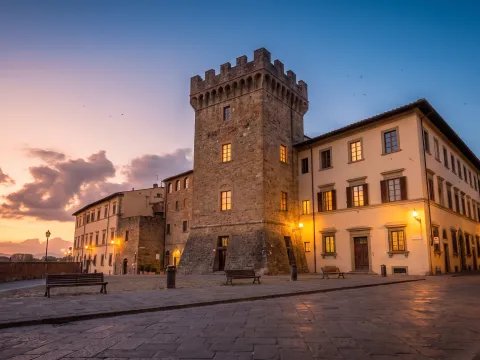
It was not born a castle: it is a seventeenth-century friary dressed up as one from 1870 onwards. On Capo Santo Spirito, the headland that closes Borghetto off towards Ceriale, the order of the Minim friars founded by St Francis of Paola had built the convent of Santo Spirito, which gave the cape its name. On those remains the engineer Borelli raised his own residence in neo-Gothic forms, and ever since everyone has called it the castle.
What to see
The building also gives its name to the little square in front of it and is the most recognisable structure in the municipality: nineteenth-century neo-Gothic looking out over the Ligurian Sea, the taste of a century that liked to dress up as the Middle Ages. Today it stands abandoned inside and out, and that too is part of what you see: not an ancient ruin, a recent one.
Borelli's building site also left an archaeological trace. In January 1871, while the castle-residence was going up near Capo d'Anzio, a grey stone altar came to light: a find that led scholars to suppose a first settlement at Borghetto as early as Roman times, on a plain that was in all likelihood inhabited by the Ligurian tribes long before. Of the earlier phase, the one belonging to the Minims, what mainly survives is the name of the cape.
Visiting
You reach the castle by the pedestrian path that links Borghetto to the Capo Santo Spirito area and carries on to Ceriale: planned in 2014, it was built in sections from 2016 to the beginning of 2025. You walk beside the sea and the building appears above you, over the coast. There is nothing to visit: it is closed and abandoned, so you look at it from outside, from the little square or from the path, without climbing any fences. From piazza Libertà, in the centre of Borghetto, Ceriale is 2.3 km away along the old via Aurelia.
Our editors' tip
Go in the last hour of daylight, walking west out of Borghetto: the sun drops in front of you, the outline of the castle stands out against the sky and the stretch takes about half an hour at an easy pace. We suggest doing the path in both directions, because the headland changes completely depending on which way you come at it. And if the castle leaves you wanting to know what Borghetto looked like before, go back into the old town: it is there, between the two longitudinal streets of the medieval borgo, that you find what the concrete of the nineteen-sixties did not erase.